Why AI content tools should be local-first
A practical architecture for keeping knowledge, drafts and credentials under the user’s control without pretending the internet disappears.
Most AI content products begin with the same request: upload your documents, paste your brand knowledge, connect your accounts and trust another cloud dashboard with the material that defines your business. That workflow is convenient for the vendor. It is not always the best default for the user.
Brand files can contain unreleased products, customer details, internal positioning and drafts that were never meant to leave the team. Publishing tokens are even more sensitive. A useful tool should not expand that trust boundary without a good reason.
Local-first does not mean offline-only
Content Operator needs an internet connection when it sends a generation request to an AI provider or publishes through a social network API. Local-first describes where the workspace lives and who controls the data path—not a claim that online generation happens without a network request.
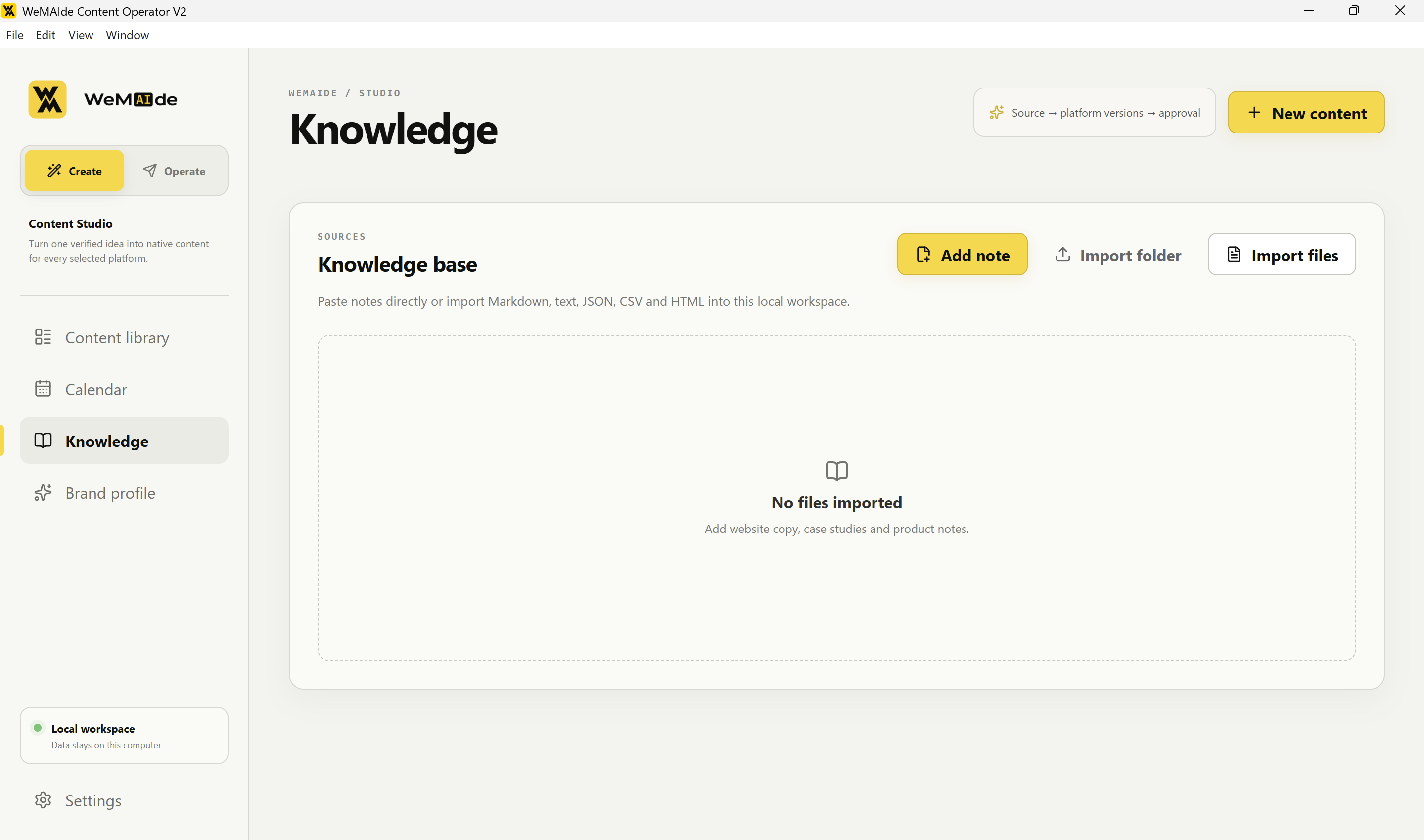
- Knowledge files, brand instructions, drafts, approval states and calendar data stay on the computer.
- API keys and channel credentials use Windows-protected encrypted storage.
- Requests go directly to the provider selected by the user, without a WeMAIde application server in the middle.
- Only the selected context needed for an operation is assembled and sent.
- OpenAI text requests use store: false.
local knowledge → local context selection → provider request → platform drafts → human approval → official publishing APIWhat still leaves the device
When a user generates text or an image, the selected prompt and context must reach the AI provider. When a user publishes, the post and authorization data required for that action reach the social platform. The difference is that those requests do not pass through an additional vendor-owned content server.
Why the boundary matters
A brand profile is operational data. A rejected draft may mention an unannounced feature. An AI key can create financial exposure, while a platform token may be able to speak publicly for a company. Keeping the permanent workspace local reduces the number of systems that must be trusted.
The trade-offs are real. Backups matter more. Multi-device synchronization is harder. Collaboration has to be deliberate. Support cannot silently inspect a customer’s workspace. Local-first is a product constraint, not a decorative privacy label.
The goal is not to remove every cloud service. It is to make each transfer intentional and keep the workspace under the user’s control.