Designing a decision layer for AI content automation
A reference architecture for separating signals, deterministic scoring, contextual AI, human approval and official publishing APIs.
A language model can produce five plausible posts in seconds. That is a throughput improvement. It is not a content decision system. If the input is arbitrary, faster generation only produces arbitrary output at a higher rate.
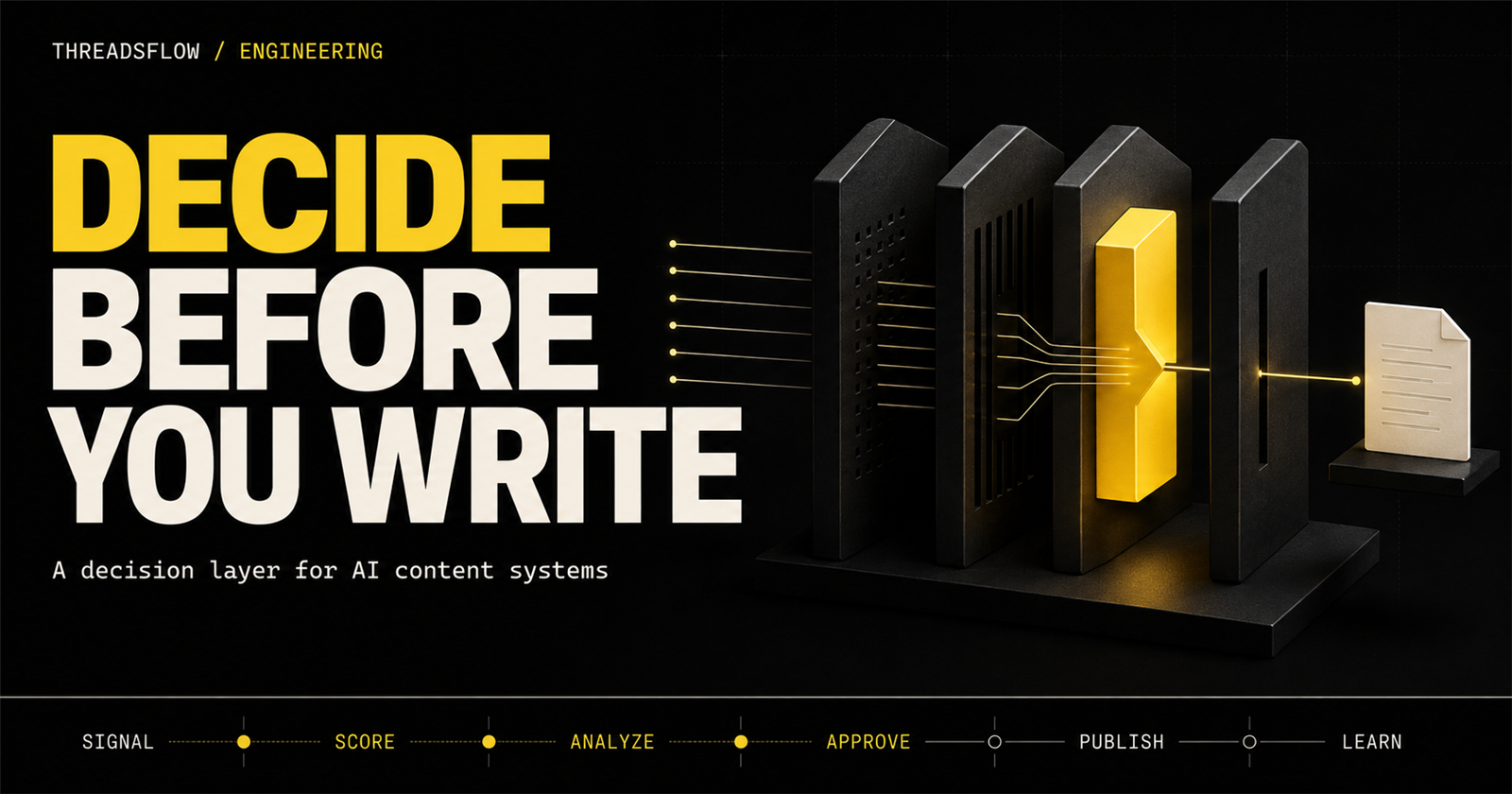
A reliable workflow needs a decision layer between raw signals and content generation. It should decide whether an opportunity is relevant, whether there is a useful angle, what risks it introduces and whether the result should be developed, held or rejected.
signals → normalization → deterministic scoring → contextual AI → policy gate → brief → draft → approval → official API → learningNormalize before judging
Opportunities arrive from search, public conversations, product events, customer questions and editorial backlogs. Scoring raw inputs directly creates accidental bias. A stable candidate record should retain its source, observation time, language, topic, provenance and normalized summary. It is evidence for a decision, not a draft.
Use fixed rules for consistency
Deterministic scoring is useful when it applies explicit criteria and versioned thresholds before a generative model is involved. The score is not a promise of virality. It is a prioritization mechanism that can be tested, compared and explained.
Give AI the contextual work
Fixed rules are weak at interpreting a new cultural reference or recognizing that a familiar topic is exhausted for a specific audience. AI can add that context, but it should return a structured assessment: recommended action, audience fit, proposed angle, risk flags and brief notes. It should inform policy rather than silently become the policy.
Route explicitly
- Reject when the opportunity conflicts with policy or lacks usable evidence.
- Hold when ambiguity or risk needs human judgment.
- Develop when the system may create a brief and draft.
- Schedule only after the exact draft has been approved.
These states are more useful than a single approved flag. They separate permission to explore an idea from permission to publish the final result.
Autonomy is a routing policy
Manual, approval-required and autonomous modes should not be personality settings for an AI. They are policies that define which transitions may happen without intervention. High-risk or ambiguous items should stop even when routine items can move automatically.
Keep publishing separate from intelligence
The publishing adapter has a narrow job: validate authorization, create the official platform request, handle rate limits and retries, prevent duplicates and expose failures. A publishing failure should not force the system to repeat discovery, scoring or generation. The approved artifact should remain available for a controlled retry.
The system earns the right to generate a post by first making the opportunity legible.
This architecture informed ThreadsFlow, our self-hosted workflow for Threads. The wider principle is platform-independent: the hard part of content automation is not generating more text. It is deciding what deserves to be created, published and learned from.