Workflow model and success criteria
Map the current task, input examples, decisions, exceptions and owner. Define what a correct result looks like before connecting a model or automating an action.
 Start a project ↗
AI / AUTOMATION
We build custom AI workflow automation for content, data processing and internal operations. Connect your tools, validate AI output and give your team clear approval, monitoring and recovery controls.
OUTCOMEAutomation handles repeatable work while important decisions stay traceable and interruptible.
 ↯
DELIVERABLES
Each engagement is scoped around the smallest complete system that can deliver the intended result.
Map the current task, input examples, decisions, exceptions and owner. Define what a correct result looks like before connecting a model or automating an action.
Stable conditions remain deterministic; AI is used for contextual work that cannot be reduced to a reliable fixed rule.
Connect approved APIs, databases and existing tools. Track each item through intake, processing, review and completion so operators can see where work stopped.
Approval points, retry behavior, logs and manual recovery are designed into consequential operations.
USE CASES
Good software starts with an operating need. These are common patterns, not fixed packages.
ThreadsFlow demonstrates a complete sequence: collect candidate topics, score relevance, generate drafts, review in Telegram and publish through the official Threads API. A custom project adapts the workflow to your sources, rules and accounts.
Long-running extraction, validation, transformation and export work that must be repeatable and verifiable.
Monitor events, apply operating rules and notify the right person with the context needed to act.
Assist recurring work from approved business knowledge without hiding the actions or the source of a decision.
PROCESS
One continuous path from product definition to build, validation and launch.
Identify the real sequence, bottlenecks and exceptions instead of automating an imagined process.
Choose what runs automatically, what needs approval and what always remains manual.
Start with the stable core, connect external services and add AI only where its role is measurable.
Use logs, failures and real outcomes to improve the workflow without rewarding activity for its own sake.
RELATED WORK
Self-hosted topic scoring, draft generation, Telegram review and official API publishing. The separate course and program cover one Threads account; custom studio work is scoped separately.
View case ↗02AI content operationsLocal content generation, approval, scheduling and supported API publishing from one workspace.
View case ↗03Data engineeringA verifiable export pipeline for a large archive the standard SDK could not read.
View case ↗FAQ
They connect a recurring business process from input to action, using AI where context or judgment is needed. A working system also needs integrations, validation, permissions, stored state and an operating interface. The deliverable is a usable workflow rather than a prompt alone.
Start with an existing tool if it supports the necessary connections, controls and data handling. Custom development becomes useful when your process needs specific state, review rules, product logic or deployment control. We scope that gap before proposing a build.
A description of the current process, a few representative inputs and outputs, the tools involved, expected volume and actions that require human approval. We use these to define a focused first release, acceptance checks and operating responsibilities.
Hosting, model or API usage, third-party subscriptions and maintenance depend on the agreed architecture. We distinguish build work from ongoing operation. The separate ThreadsFlow course price is not the price of a custom studio implementation.
No. Reliable fixed rules are preferable whenever the decision can be expressed deterministically. AI is added only for contextual work where it creates real value.
Yes. Manual, approval-required and more autonomous operating levels can be designed around the consequence of each action.
Usually, when those tools provide suitable APIs or another approved integration path. We confirm access and limitations before promising the connection.
Yes. Self-hosting is an option for workflows that need owner-controlled infrastructure, credentials and operating costs.
RELATED INSIGHTS
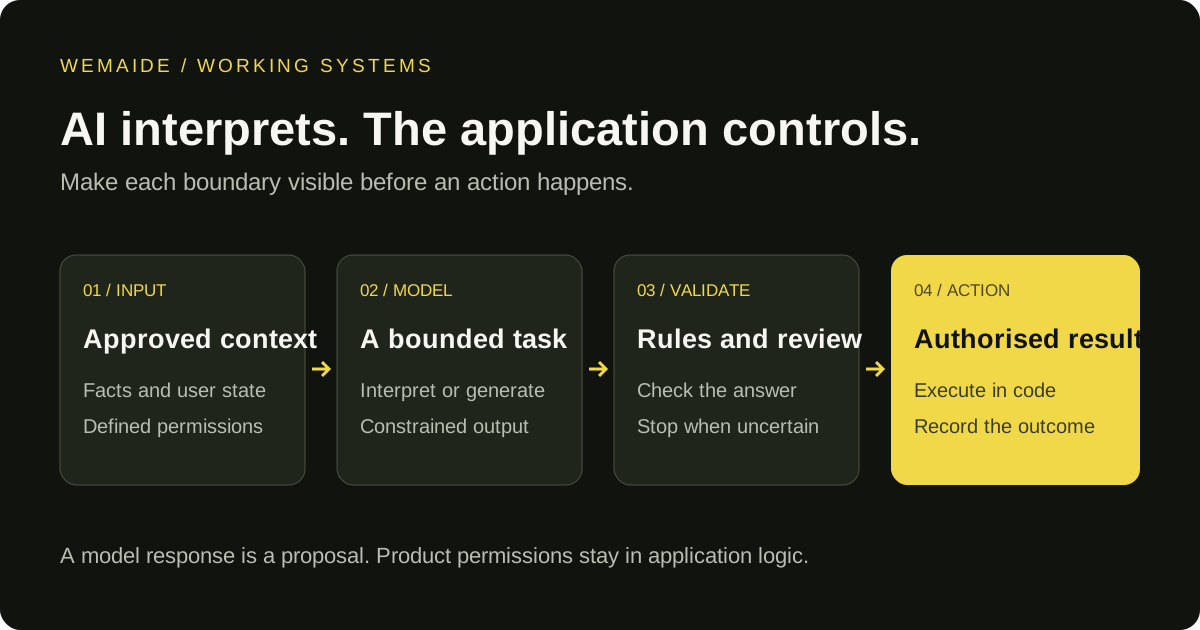
See how WeMAIde combines AI with repeatable workflows in ThreadsFlow, Content Operator and Horoscope, plus a data-export example that does not need AI.
Read insight ↗
A practical decision framework for choosing deterministic automation, an AI agent or a controlled hybrid system.
Read insight ↗
A practical architecture for placing human approval at consequential AI decisions without turning every workflow into a queue.
Read insight ↗Choose where integration logic belongs in n8n. Compare HTTP Request, Code and custom nodes with a separate service using one concrete API workflow.
Read insight ↗START A PROJECT
Tell us what needs to work. We will come back with the clearest next step.
Discuss it in Telegram ↗