WEMAIDE / INSIGHTS / ENGINEERING
AI automation examples: three working systems and where the rules stay in code
See how WeMAIde combines AI with repeatable workflows in ThreadsFlow, Content Operator and Horoscope, plus a data-export example that does not need AI.
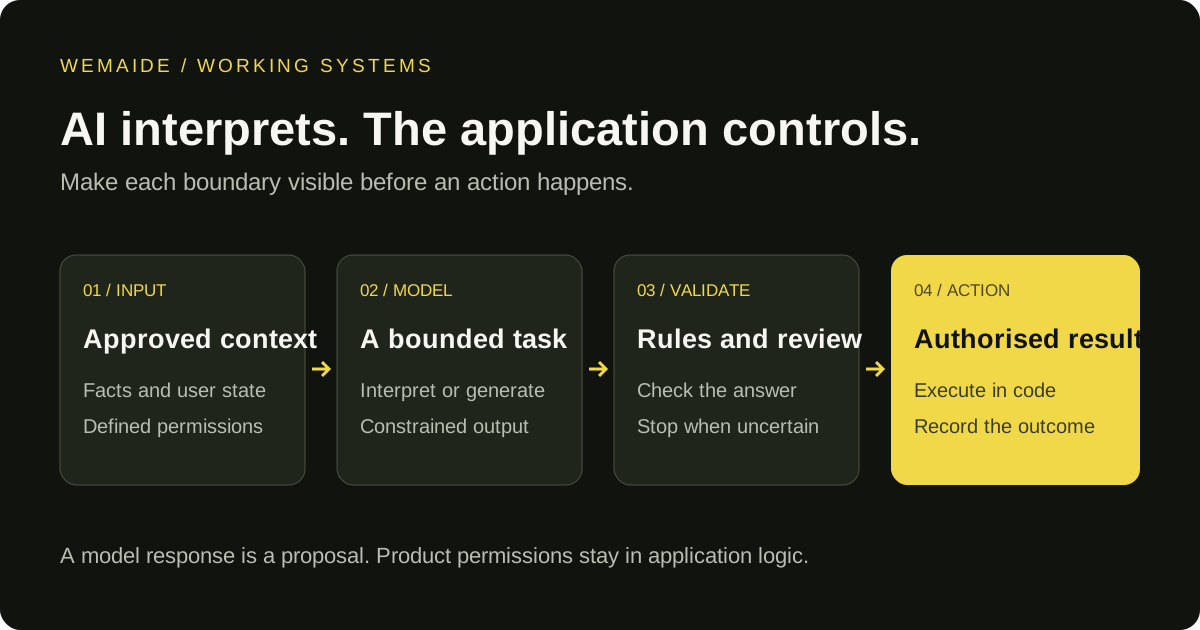
Useful AI automation examples show the whole job: what arrives, which decision needs a model, which rules remain fixed, who reviews the result and what action happens next. A generated paragraph alone is not a complete operating workflow. Below are three systems we have built, with different boundaries between AI and application logic.
These are product examples, not promises of a particular saving for another business. We do not have a controlled before-and-after productivity study for each system, so we describe the observable workflow and its limits instead of inventing percentages.
Compare the workflow before copying the tool
| Process | Input and AI task | Application rules | Person and recorded result |
|---|---|---|---|
| ThreadsFlow | Candidate topic and account context → evaluated material and draft | Scoring, workflow state, configured review mode and official API access | Operator controls; inspect the actual publication result |
| Content Operator beta | Idea and selected knowledge → separate platform drafts | Draft and Ready states; supported explicit publishing connections | Operator reviews and chooses Publish now; no unattended background publication |
| Horoscope | Prepared content pool → variants for signs and reactions | Stored preferences, content selection, schedules and delivery logs | Subscriber selects a schedule; an operator can inspect and pause operation |
These processes share a pattern, but their product controls are different. The comparison describes their public scope; it does not assert that each has the same approval receipt, retry guarantees or measured productivity improvement.
1. ThreadsFlow: from candidate topic to controlled publication
ThreadsFlow is a self-hosted content workflow for Meta Threads. Candidate material enters an evaluation pipeline: mathematical scoring helps select opportunities, AI analyses context and prepares drafts, and Telegram provides operator controls before publication through the official Threads API. The account profile, chosen sources and operating mode shape what the system is allowed to do.
- Input: candidate topics and the account’s audience, language, voice and approved facts.
- AI task: interpret the candidate and create a suitable draft within that account context.
- Application responsibility: scoring, state, scheduling, API access and the configured review boundary.
- Operator result: inspect a draft and decide whether the workflow should publish, change or stop it.
This is a useful pattern when material arrives repeatedly and publication needs both judgment and a consistent process. It does not guarantee audience growth. The separately sold course and program cover one Threads account; a studio project for different sources, team roles or several accounts needs its own scope.
2. Content Operator: source knowledge to reviewed platform drafts
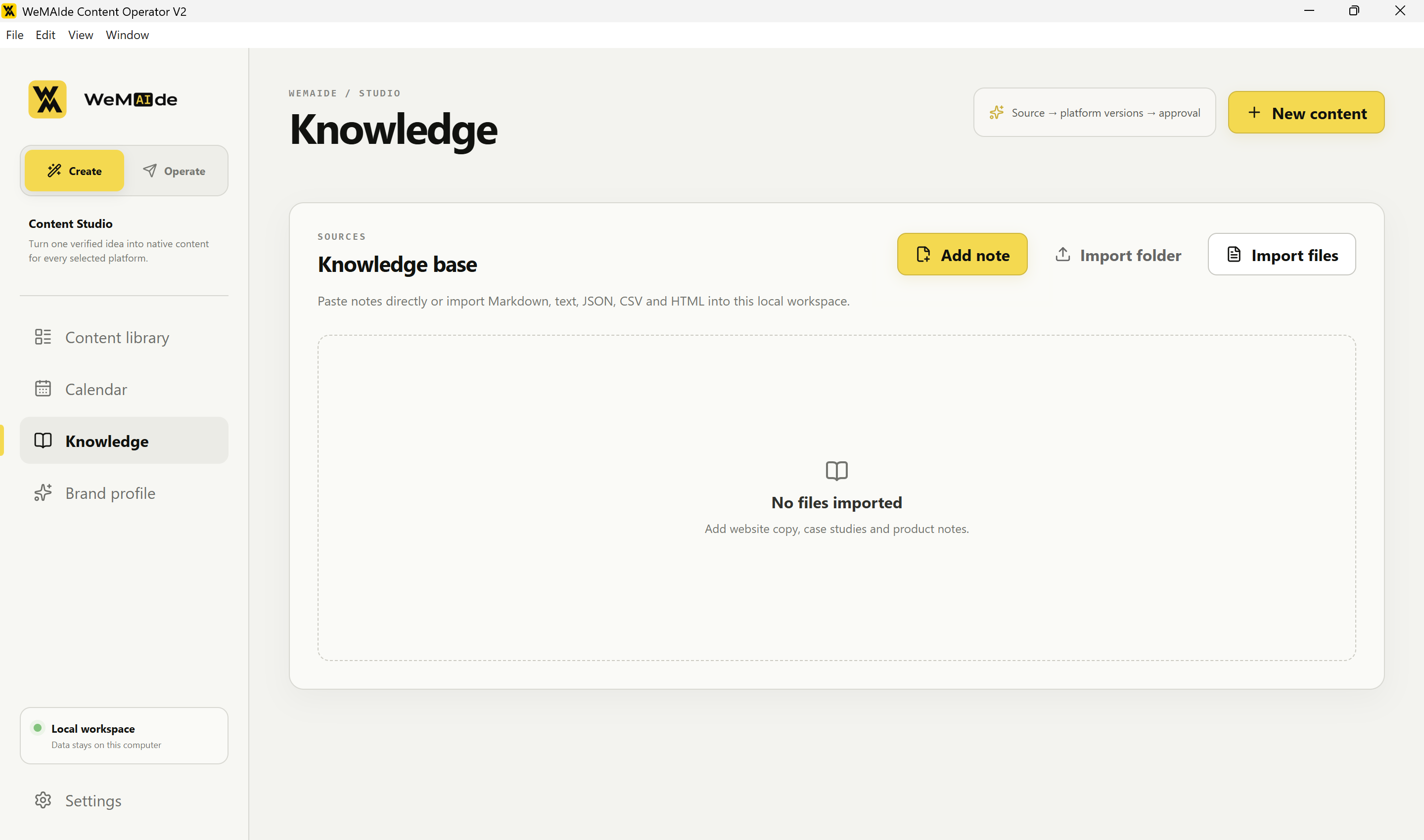
Content Operator is a Windows application with a local workspace for brand knowledge, content and review. It assembles selected context for an AI request and prepares drafts in six platform formats. The person operating the application can inspect and approve the material before using the supported publishing connections.
The distinction between a draft format and a publishing integration matters. Six supported generation formats do not mean unattended publishing to all six networks. The product is a beta; background operation and publishing capabilities must be checked against the current supported release and configured connection.
- Input: selected brand facts, source material, instructions and the intended content task.
- AI task: generate platform-specific drafts and related assets from that selected context.
- Application responsibility: the local workspace, draft and approval states, and explicit supported publishing actions.
- Operator result: review content in one place while retaining control over what leaves the workspace.
Local storage does not make online generation offline. Selected context still goes to the chosen AI provider, and approved publishing sends content to the selected platform. This boundary is important when deciding whether a similar application suits internal documents or unpublished material.
3. Horoscope: generate a content pool, then deliver by user preference
Our Horoscope bot separates content generation from delivery. A nightly content pool prepares variants for twelve signs and five reaction types. PostgreSQL holds variants, schedules and logs; the bot delivers personal content at the user’s selected local time across the eight time zones described in the case. Russian and Ukrainian content serve the product’s chosen audience.
Here AI creates the variable content. Stored preferences, selection and delivery are application responsibilities. The benefit of the architecture is that every button press does not have to trigger a fresh generation request. That is a design principle, not a claim that model costs never change or that any audience size has identical infrastructure requirements.
- Input: the product’s content rules and the subscriber’s sign, language and delivery preference.
- AI task: prepare the content variants before the delivery window.
- Application responsibility: store variants and preferences, select content and operate delivery and pause controls.
- Operator result: manage the content service through its administrative tools rather than regenerate every response manually.
A useful contrast: an export pipeline that does not need AI
Pi Mainnet Export addressed a large data archive that the standard SDK could not read. The relevant work was a verifiable extraction and export pipeline. Exact identifiers, completeness checks and reproducible output are tasks for deterministic code. Adding a language model would not automatically make that system better.
This is why business process automation and AI automation should not be treated as synonyms. A process may need integrations, queues, validation or an operator interface while requiring no generative judgment at all.
Choose a first workflow using evidence you already have
- Collect representative inputs and examples of an acceptable result, including a few difficult cases.
- Mark the step that needs interpretation. Keep calculations, permissions and exact transitions in code.
- Define what a person must review before an external action occurs.
- Decide how an invalid answer, an unavailable provider or a stale approval should stop the workflow.
- Choose an outcome you can observe: valid records, reviewable drafts or completed deliveries, rather than a count of model calls.
Start with one complete operating task and compare its results with the current process. Reuse a standard tool when it fits. Custom development is useful when the business needs its own state, permissions, context or interface around that task. The examples above show different ways to draw those boundaries; they are not a reason to rebuild every existing tool.
Worked teaching example: a request becomes a reviewed follow-up
Suppose a synthetic enquiry says: We need a Telegram booking bot that writes confirmed requests to our CRM. The model can extract a proposed category and prepare a follow-up draft. Fixed validation checks that the required fields exist and that a destination is allowed. The operator compares the draft with the original request and decides whether to send it. This is a teaching scenario, not an additional client case.
| Step | Illustrative result | What must remain inspectable |
|---|---|---|
| Receive | Submission demo-0042, revision 1 | The source request and consented contact route |
| Propose | Category: booking integration; draft asks which CRM is used | Model output as a proposal, with missing information identified |
| Validate | Known destination; no invented quote or delivery promise | Rule results and the exact proposed action |
| Review | Operator edits and approves the current revision | A decision scoped to the reviewed content and destination |
| Execute | Attempt one permitted follow-up | Confirmed external identifier, or an explicit uncertain outcome |
If the CRM write succeeds but the acknowledgement fails, recover that acknowledgement separately. If the request changes after review, return the changed proposal for another decision. This is the difference between an interesting generated response and a workflow an operator can recover.