WEMAIDE / INSIGHTS / GUIDES
AI app development cost: budget the feature, the product and its operation
Estimate an AI application's build and running costs: scope, integrations, testing, model usage, maintenance and a transparent worked token-cost example.
The cost of an AI application depends on what you are building around the model. Adding draft generation to an existing screen, releasing a desktop workspace and building a hosted application with multiple customer accounts are different projects.
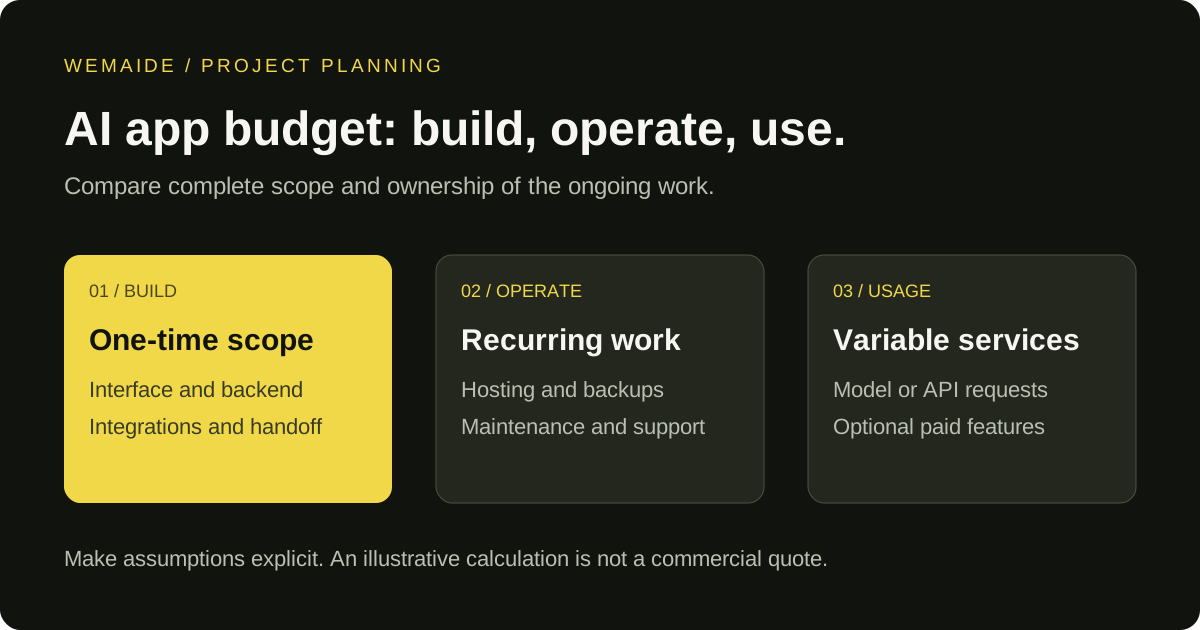
Start a budget with three separate totals: initial delivery, recurring operation and later changes. An API usage estimate answers only part of the operating-cost question. It does not estimate the work needed to build the application.
Which scope are you pricing?
| Scope | What the estimate must cover |
|---|---|
| AI feature in existing software | Current authentication and data access, the new task, output handling and the changed screen |
| Internal application | Operator access, records, integrations, review controls and the operating environment |
| Packaged desktop product | Local state, update and installation paths, supported machines and online dependencies |
| Hosted customer-facing application | Account boundaries, deployment, usage controls, support and any agreed billing flow |
Do not compare a prototype estimate with a release estimate as if they purchase the same deliverables. Ask each supplier to state what a user can complete, which environment is supported and who owns ongoing operation.
Build the estimate from delivery blocks
For each block, record an owner, an effort estimate, the agreed rate or fixed price, assumptions and an acceptance check.
- Scope and examples. Define the task, expected output and material needed to evaluate it.
- Interface and application state. Include loading, review, correction, archive and failure behaviour where the workflow requires them.
- Data and integrations. Check API access, record mapping, permissions, migration and update behaviour.
- Model handling. Prepare context, validate results and define attempt limits and fallbacks.
- Evaluation. Test ordinary inputs, unsupported answers, inaccessible records and provider failures.
- Release and handoff. Include deployment or installation, configuration, documentation and operating responsibilities.
The initial delivery total is the sum of these agreed blocks and any separately identified allowance for unresolved work. Keep an uncertain integration visible rather than hiding it inside an optimistic total.
WeMAIde’s minimum project budget is USD 1,500. This is a minimum engagement threshold, not a quote for a complete AI application or a promise that every scope fits that amount. The actual estimate follows the brief and integration assessment.
Calculate model usage from actions, not account count
Define a billable action in your product. One user action may cause multiple model requests. The request may contain instructions, retrieved context and prior messages in addition to the visible input.
For a simplified text-only example:
model cost = actions × requests per action × ((input tokens × input rate) + (output tokens × output rate)) / 1,000,000Here, each rate is expressed in dollars per million tokens. Actual provider billing may also include cached input, reasoning output, images, audio, tools or other charges. The selected provider’s current terms determine which categories apply; the Gemini API pricing documentation illustrates the need to check the exact model and processing mode.
A worked example with deliberately hypothetical prices
Assume 10,000 monthly actions, one model request per action, 1,500 input tokens and 300 output tokens. For illustration only, choose an input rate of USD 1 per million tokens and an output rate of USD 5 per million tokens. These are invented calculation inputs, not a provider tariff or a WeMAIde quote.
The input component is USD 15 and the output component is USD 15: USD 30 in total. If average usage becomes 1.3 requests per action with the same token profile, that component becomes USD 39.
This is only the model-call component under those assumptions. It excludes hosting, storage, monitoring, other APIs, human review, support and development. Replace every assumption with measurements from a representative pilot.
Try an AI application budget with your own assumptions
Use the calculator to separate delivery, model requests and recurring operation. The initial values are deliberately hypothetical. Replace token counts with representative measurements and rates with your selected provider’s current prices. Include any additional services in the monthly non-model costs field.
PLANNING MODEL · USD
AI application cost calculator
Illustrative inputs, not provider tariffs or a WeMAIde quote. Separate development from recurring use. Taxes, payment fees and later scope changes are excluded. Calculations stay in this page.
One-time delivery$4,800.00
Monthly model requests$30.00
Total monthly operation$230.00
Delivery + first 12 months$7,560.00
Model usage = actions × requests per action × (input tokens × input price + output tokens × output price) ÷ 1,000,000. Monthly operation adds the other monthly costs and maintenance.
A reusable plain-text brief for one feature, its data, permissions, budget assumptions and acceptance checks. No registration required.
Add operation and maintenance explicitly
The monthly budget should name infrastructure, storage and retention, external services, model usage, support and planned maintenance separately. Decide who responds when a provider changes, an integration stops working or a user reports an incorrect result.
Some costs follow a schedule or user activity rather than total registered users. In the published Horoscope case, content preparation and delivery are separated using stored variants. That architecture shows why “one user equals one fresh model request” is not a universal budgeting rule. It does not establish free operation at any audience size.
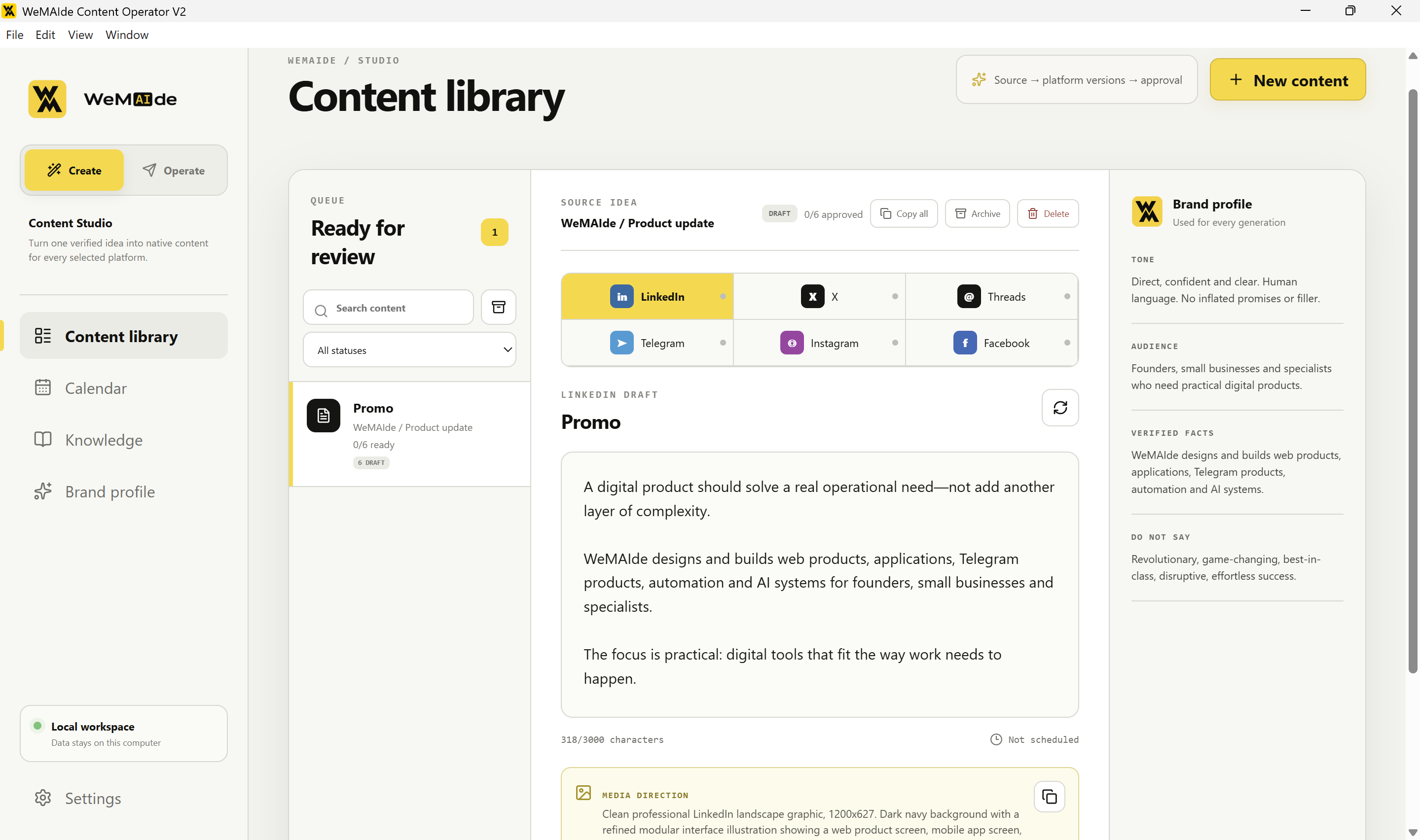
Content Operator demonstrates another scope: a local-first Windows workspace in available beta. Packaging, local state and review controls are part of that product. A hosted multi-tenant service would require a different estimate.
Reduce the first release without removing its acceptance checks
Choose one audience, one input path and one useful result. Reuse an existing login or supported API where it fits. Limit the first model task and introduce consequential external actions only when the required controls are included.
Keep the evaluation and failure path in scope. Removing those lines makes an estimate smaller by changing what is being delivered.
What should a useful proposal contain?
Ask for the defined user journey, included integrations, output acceptance checks, deployment route, ownership and handoff terms, external dependencies and the basis of the usage estimate. Unresolved questions should have a discovery step or an explicit assumption.
For application or feature delivery, see custom AI software development. For a process connecting existing tools, see AI automation development. If the actual interface is Telegram, use the separate Telegram bot cost guide to scope that delivery layer.
Integrating AI into existing software changes the delivery scope
The same visible AI feature can require very different implementation work. Before using the calculator, inspect the current application's interfaces, data ownership and release process. Token prices alone do not price an integration.
| Starting condition | Additional work to include | Evidence needed for an estimate |
|---|---|---|
| Documented API and stable permissions | Mapping, validation, credentials, errors and acceptance checks | API documentation, representative sanitized payloads and a test environment |
| Legacy software without a suitable API | Supported access path, adapter or migration, plus reconciliation | Vendor-supported interfaces and constraints; avoid assuming screen automation is durable |
| Several customer organisations | Tenant isolation, per-organisation permissions, configuration and usage attribution | Ownership model and examples of authorised and forbidden cross-tenant access |
| Actions needing human review | Review interface, changed-draft policy, execution checks and outcome records | Who may approve which action and how uncertain results are resolved |
| Long or bursty processing | Queue, durable jobs, provider limits, timeouts and operator recovery | Expected volume, peak pattern and acceptable delay |
These are scope drivers, not fixed price bands. Use explicit assumptions in the calculator, distinguish one-time delivery from recurring operation, and replace assumptions with measurements from a representative test before committing to a budget.