WEMAIDE / INSIGHTS / GUIDES
How much does it cost to build a Telegram Mini App in 2026?
Realistic planning ranges, cost drivers and scope decisions for turning a Telegram Mini App idea into a production product.
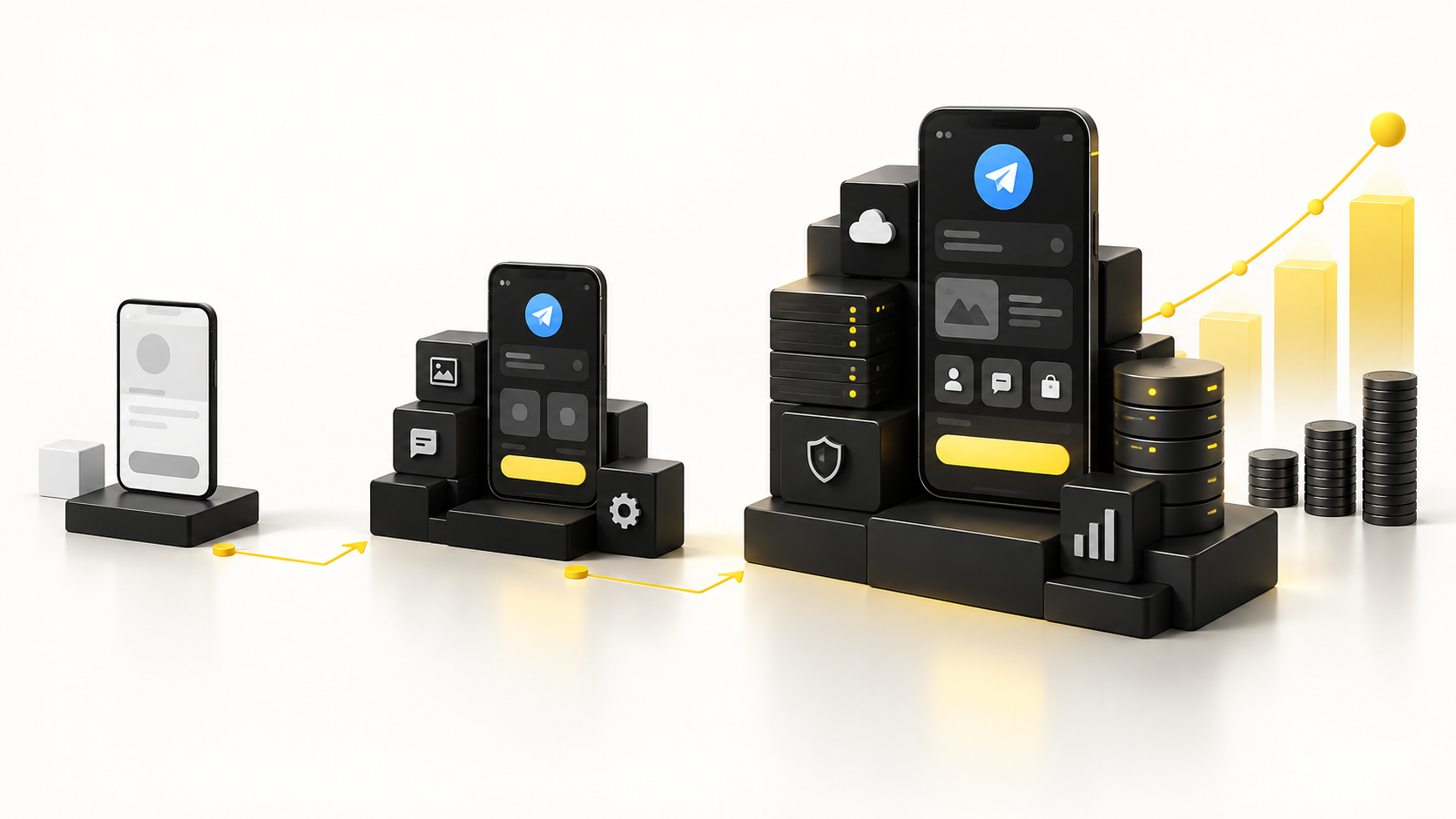
A useful 2026 planning range for a custom Telegram Mini App is about $5,000–$15,000 for a focused MVP, $15,000–$40,000 for a production product with a real backend, and $40,000+ for a complex service with several roles, payments, integrations or demanding operations. A narrow validation prototype can cost less. A marketplace, financial product or business-critical platform can cost substantially more.
These are WeMAIde planning ranges, not a universal market price list. Geography, team structure and technical constraints change the number. More importantly, two products that look equally simple in a screenshot can have completely different work behind the interface. The reliable estimate starts with the operating system around the screens.
The short cost map
Validation prototype     $2,500–$5,000   · 2–4 weeks
Focused working MVP      $5,000–$15,000  · 4–8 weeks
Production Mini App      $15,000–$40,000 · 8–16 weeks
Complex connected system $40,000+        · scope-led
A validation prototype proves one uncertain assumption with limited data and temporary operations. A focused MVP completes one genuine user loop and can be used by a controlled audience. A production product adds the security, administration, observability and failure handling required for continued use. Those are different deliverables, even when all three are called an MVP.
What Telegram gives you—and what it does not
Telegram supplies a valuable product surface: a Mini App opens inside the client, can use Telegram launch context, adapt to themes, work with a bot and support payment flows. Telegram’s documentation currently describes seven launch methods, from the bot profile and menu button to direct links and inline actions. That can remove a separate download and registration journey.
It does not remove the need for product logic. Authentication data must be validated on the backend before it is trusted. Orders, permissions, content, subscriptions, analytics and account state still need a reliable home. The bot must know when to notify, recover or return the user to the interface. Telegram is the distribution and interaction layer—not your entire application architecture.
The interface may live inside Telegram. The product still needs identity, state, rules, operations and a safe failure path.
Seven decisions that change the estimate
- User roles and permissions. One consumer flow is different from customers, operators, moderators and administrators sharing the same system.
- Backend state. A catalogue with static content is cheaper than accounts, inventory, bookings, subscriptions or long-running user history.
- External integrations. Every CRM, payment provider, AI service or legacy API adds access work, error states and ongoing dependency risk.
- Payments and entitlements. Physical goods, digital goods, Telegram Stars, refunds and subscription access each create different product and compliance paths.
- Bot behavior. Notifications, commands, deep links, group context and recovery messages must be designed together with the Mini App.
- Administration. Someone needs to manage content, users, orders, permissions and exceptions after launch—even if users never see that interface.
- Operational quality. Analytics, logs, backups, monitoring, abuse protection and deployment are what turn a demo into a service.
What a focused MVP should include
The best first release is not the smallest number of screens. It is the smallest complete loop. A user should be able to open the product from a real Telegram entry point, be identified safely, understand the offer, complete the primary action, receive confirmation and return later without losing state.
- One primary audience and one measurable job to complete.
- A Telegram-native launch and return path rather than a generic web landing page.
- Server-side validation of Telegram initialization data and a defined session model.
- The minimum backend, database and operator controls needed to deliver the promise.
- Real empty, loading, expired, interrupted and failed states on mobile devices.
- Analytics for launch, activation, completion and failure—not only page views.
- A deployable environment and a clear owner for content, support and updates.
Why the cheapest quote can become expensive
A low estimate often excludes work rather than removing it. The missing pieces return as manual operations, fragile spreadsheets, unprotected admin routes or a rewrite after early users arrive. Ask whether an estimate includes backend development, bot behavior, deployment, analytics, administration, testing and a post-launch handoff. If those responsibilities are not in the quote, identify who owns them.
The largest hidden cost is usually not visual polish. It is ambiguity. When catalogue rules, permissions, payment states or operator responsibilities are decided during implementation, development becomes a sequence of expensive reversals. A short product discovery phase can reduce total cost more effectively than cutting screens after the architecture is already wrong.
How to reduce cost without weakening the product
- Choose one complete user journey and postpone adjacent audiences.
- Reuse a proven identity, payment or messaging service when ownership of that infrastructure creates no advantage.
- Keep stable business rules deterministic and add AI only where contextual judgment is valuable.
- Use the bot for notifications and short choices; use the Mini App where visible state and richer controls matter.
- Define operator work before building automation. A manual back-office step is acceptable when it is explicit and measurable.
- Prototype the riskiest integration first, not the easiest screen.
When a Mini App is the economical choice
A Mini App can be especially efficient when the audience already lives in Telegram, fast distribution matters and the product benefits from bot notifications or chat context. It can avoid separate App Store and Google Play releases while keeping one web technology stack. It is less attractive when the experience depends on deep device integration, background capabilities unavailable in the container or an audience that rarely uses Telegram.
For an estimate, bring the user, primary action, required integrations, business rules and operator responsibilities—not a screen count. We can then separate a validation build from the production path and show which decisions materially change the budget.
Sources and related material