WEMAIDE / INSIGHTS / GUIDES
Telegram development resources: from product choice to operation
Choose a Telegram bot or Mini App, budget the first useful release, plan integrations and prepare launch checks. A guided route through WeMAIde's practical resources.
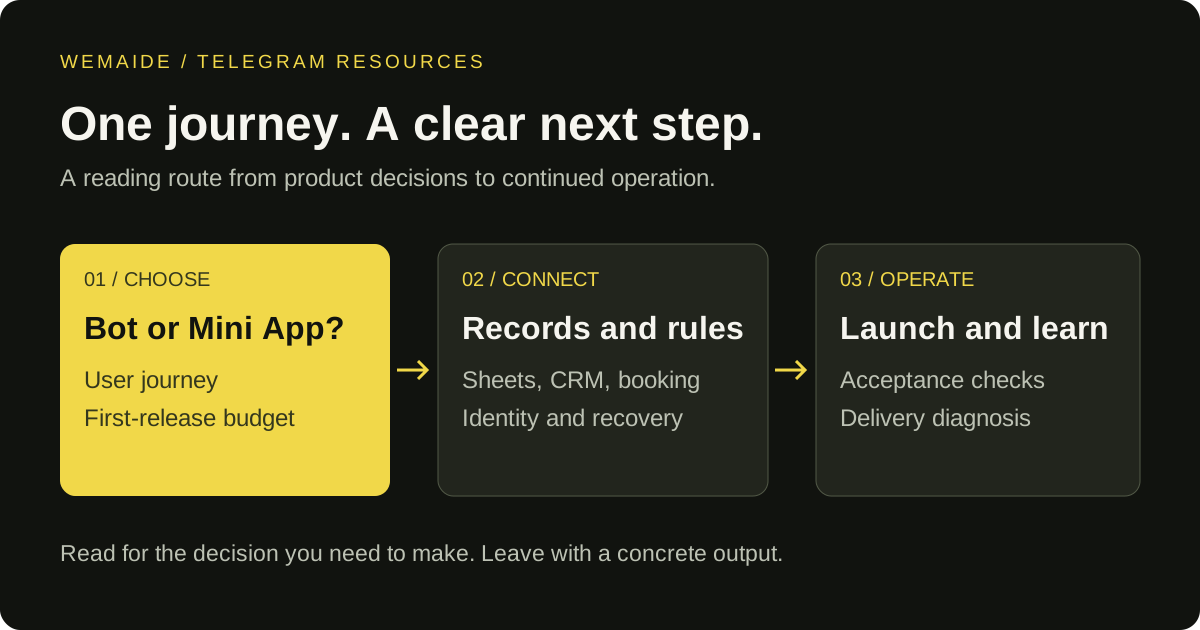
Start with the decision you need to make, rather than reading every Telegram tutorial in order. This resource guide connects product choice, budget, integrations and operation. Each step names a concrete output to agree before moving on, and points to a deeper guide when you need implementation detail.
For a new product, follow the route from the first user journey to launch. For an existing bot, jump to the integration or delivery problem you are investigating. The resources include planning examples and a downloadable Telegram/Sheets reference; they are not a complete ready-to-deploy application or proof that every illustrated scenario is a delivered client project.
Start with the decision in front of you
| Your situation | Start here | Output to agree |
|---|---|---|
| You have an idea but no interface decision | Bot versus Mini App | One complete journey and the interface it needs |
| You need a realistic first-release budget | Bot or Mini App cost guide | Build scope, recurring operation and exclusions |
| Requests must reach a spreadsheet or CRM | Integration guides | Record owner, field mapping and recovery policy |
| Customers need appointments or reminders | Booking and local-time scheduling | Availability authority, time-zone rule and confirmation states |
| A running bot stops delivering | Message-delivery diagnosis | A known test event traced to its failing boundary |
Choose the first complete user journey
Write down who starts the interaction, what they supply and what the product must truthfully confirm. A request-capture flow can finish when an operator receives an enquiry. A booking flow has a different promise: the system must reserve an available appointment before saying it is booked. Making that distinction early prevents a small interface from hiding an undefined backend.
A bot can suit commands, notifications and a guided conversation. A Mini App can provide a custom web interface for browsing, forms or a calendar inside Telegram. The two can work together. Choose on the complexity of the task and the intended user experience, then identify which backend keeps the authoritative records. Telegram's official feature guide describes the platform capabilities; our comparison helps turn them into a product decision.
Budget the build and the work after launch
List the smallest complete journey, the external systems involved and the administration needed to support it. Separate design and development from hosting, maintenance, provider usage and operator work. An estimate for the interface alone does not describe the cost of running a useful integration.
Use the bot calculator to explore your own assumptions rather than treating its result as a quote. For Mini Apps, compare a prototype, a focused first release and a product that needs continued operation. Keep optional AI, payments and complex synchronisation visible as separate scope decisions. You should leave this step with an explicit first release and a list of things it does not yet promise.
Decide where records live before connecting APIs
Choose the system that owns the business record. A spreadsheet can be a useful operator destination, while a CRM may own lead stages and a scheduler may own availability. For every external write, define the confirmed submission, field mapping, returned evidence and what an operator does when the response is lost. A timeout alone does not establish whether the target accepted the write.
The Sheets guide includes a downloadable Node.js reference and an offline demo using synthetic data. It demonstrates replay handling and uncertain-write recovery without asking you to connect real accounts. The CRM guide helps define mapping and ownership for a different target. Neither should be read as a universal transaction across Telegram and every connected service.
Add booking, scheduling or AI around explicit rules
If users book appointments, identify the authoritative reservation boundary and how competing requests are resolved. If the bot sends recurring reminders, store the user's time zone and a clear policy for clock changes, missed jobs and uncertain delivery. A visible time in a message is not enough to define the scheduling rule.
AI can help interpret an enquiry or prepare a response. Availability, identity, permissions and the decision to perform an external action still need application rules. Start with the capability the journey requires; do not add a model to a deterministic reminder or reservation step merely because the interface is conversational.
Prepare a launch check that follows one request
Agree on a small acceptance set before launch. Use synthetic records and a controlled destination while checking the flow. The important evidence is what the system recorded and confirmed, including how it behaves after interruption. Passing the happy path once does not exercise the recovery paths.
- Complete one valid journey and locate its business reference in the authoritative system.
- Repeat the same confirmation and check the documented replay policy; submit a genuinely new request and keep it distinct.
- Change a request after review and verify which validations and decisions must run again.
- Interrupt a target response and check that an unknown outcome is visible instead of silently repeated.
- Check who can view or change a record, which data enters external services and how access can be revoked.
- Verify the time zone and revision of reminders, plus how cancellation or rescheduling invalidates old work.
- Give an operator a way to identify, inspect and resolve an incomplete request.
Operate and diagnose the product after release
A bot that receives no updates, a handler that loses a job and an outgoing message rejected by Telegram are different failures. Trace one known test event through receipt, processing, the business write and notification. Use the configured update transport and inspect the available result evidence before changing deployment settings.
Telegram documents long polling and webhooks as update mechanisms. Switching between them needs a deliberate handling policy for pending updates. The diagnostic guide connects those API facts to a practical investigation, including permissions, queues and uncertain results. Keep ownership of monitoring, provider changes and failed-job recovery in the handover.
Turn the reading route into a first-release brief
Bring together the user journey, interface choice, record owner, integrations, budget assumptions, acceptance checks and recovery owner. That is enough to discuss a specific build or compare an existing tool against your requirements. If a current service already completes the journey and exposes the needed integration, include it in the comparison.