WEMAIDE / INSIGHTS / GUIDES
12 Telegram Bot Ideas for Business — With Screens and Workflows
Bookings, quotes, orders, memberships and back-office jobs. Twelve practical concepts from WeMAIde, with sample chats and a sensible first release for each.
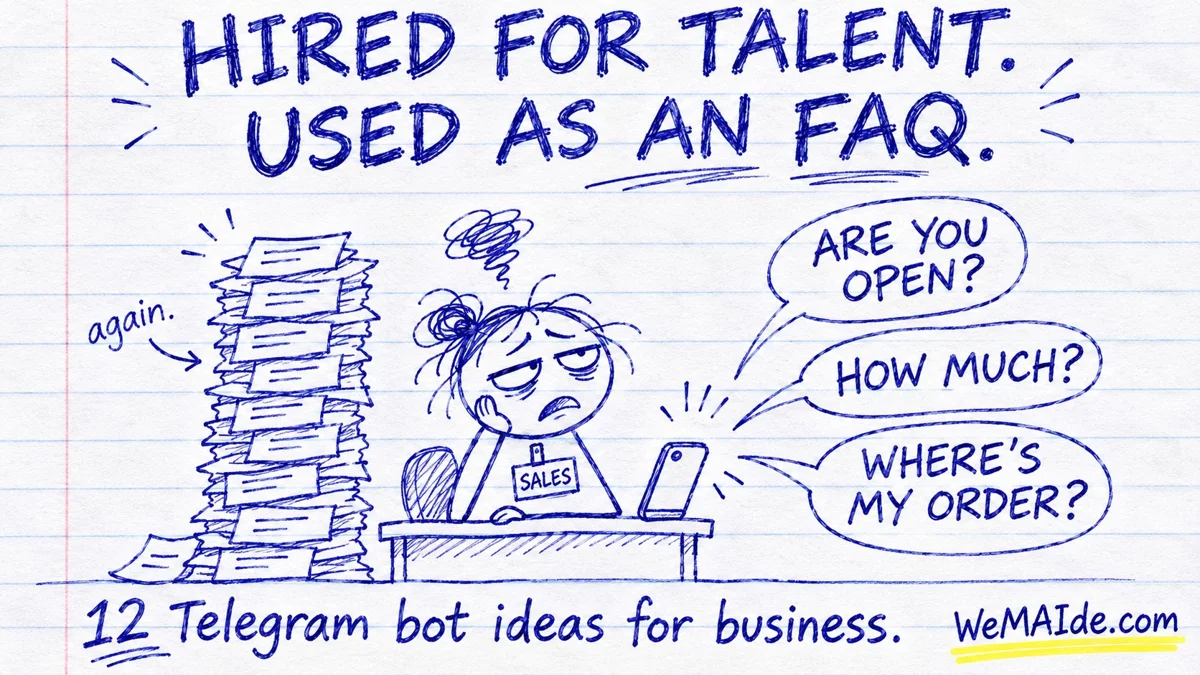
Your best salesperson is answering “Are you open on Saturday?” again. In another chat, somebody wants the tracking link. A third customer is negotiating a haircut as if national borders might change.
The customers need answers. Your team could use a shorter route to giving them.
A useful Telegram bot has a specific job: collect the details, look up the right record, deliver an update or put a decision in front of the right person. Give it one of those jobs and you can explain what you are buying.
Here are twelve Telegram bot ideas for business, designed as practical WeMAIde concepts. Each includes an illustrative conversation, the first version worth building, the information it needs and the point where a person or another system takes over.
All names, records, products and numbers in the chats are fictional sample data. These are design examples to adapt with your development team, not twelve shipped client projects or ready-made bots for download.
Find the job your team repeats
| Business problem | Ideas to explore |
|---|---|
| Customers keep asking the same thing | Start with FAQ, order status or a support handoff: ideas 1, 4 and 9. |
| A sale takes too much back-and-forth | Look at appointment requests, quote intake or product selection: ideas 2, 3 and 6. |
| People want to return, join or get access | Consider reorders, waitlists or membership: ideas 5, 7 and 8. |
| Your team keeps chasing information | Try document intake, approvals or an operations digest: ideas 10, 11 and 12. |
1. The FAQ bot that gives your team its voice back
Shops, studios and local services. Opening hours. Location. Parking. What to bring. Your team knows the answers so well they could deliver them under general anesthesia. Put the approved answers behind a few clear buttons, with a route to a person when the question gets specific.
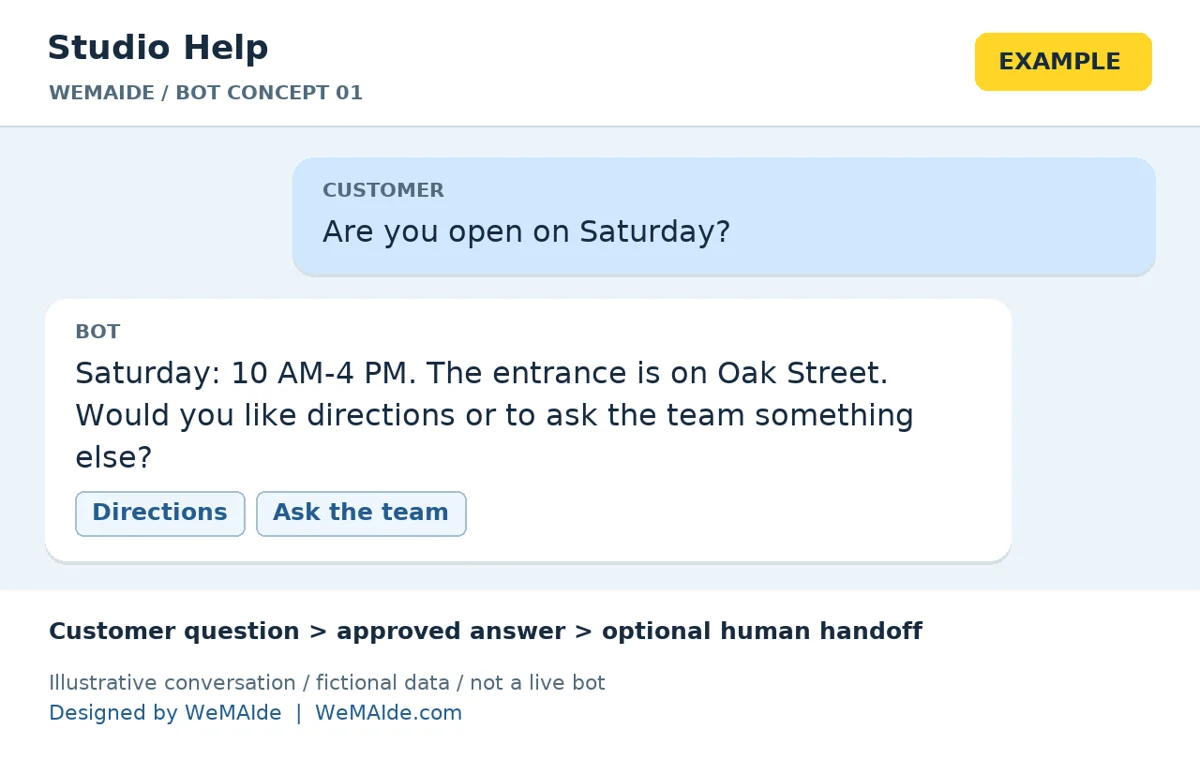
- First release. Ten approved answers, hours and location, plus one monitored handoff route. Plain buttons and maintained copy may be enough; open-ended AI can wait until there is a reason for it.
- What it needs. A named owner for opening hours, holiday changes, prices and service information.
- Boundary. An unsupported question should reach the team. A confident guess about tomorrow’s opening hours is still a guess.
- Deliverable. A compact FAQ bot with editable answers and a staffed fallback.
2. The appointment bot that ends booking ping-pong
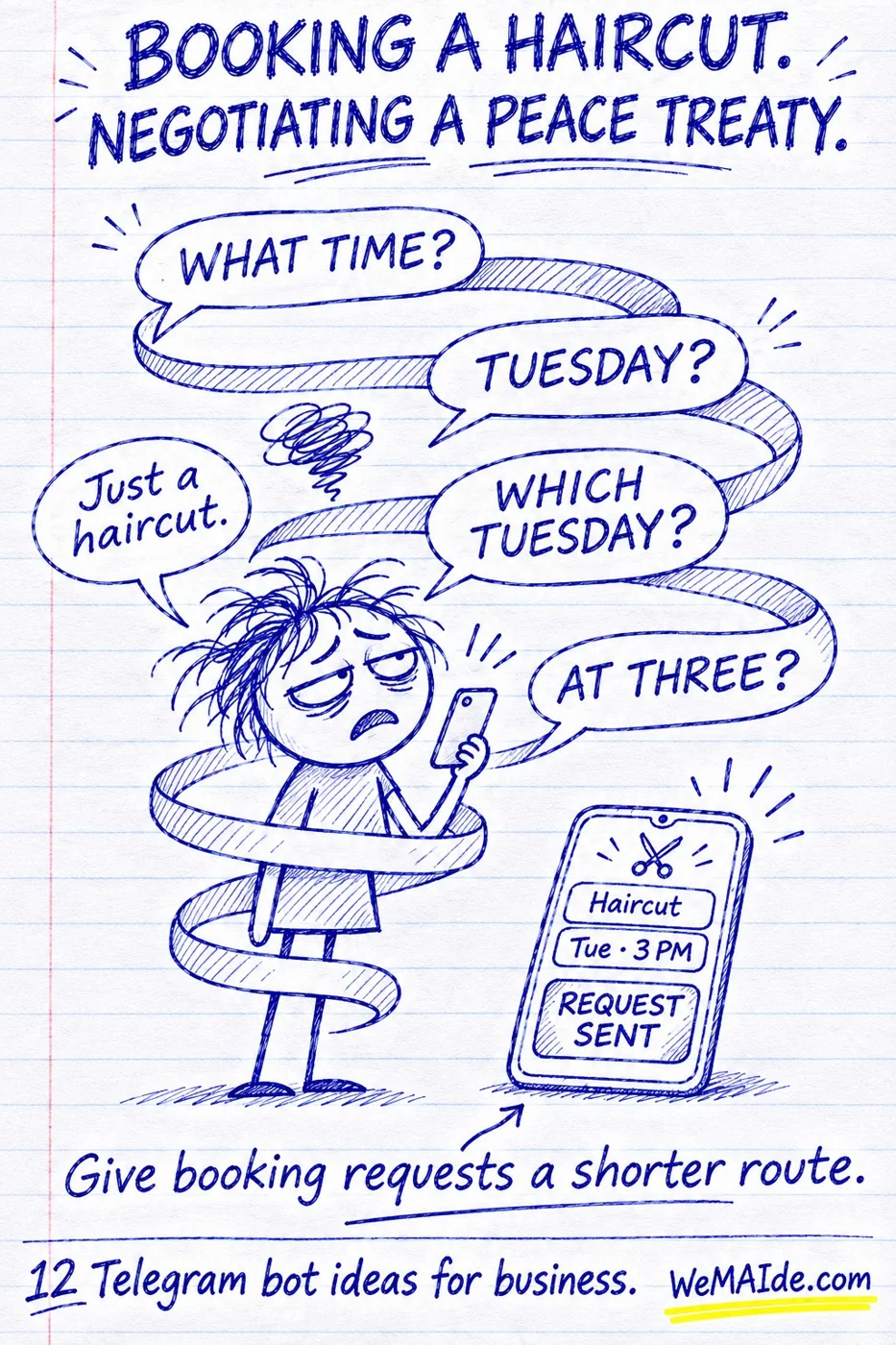
Barbers, salons, repair appointments and consultations. “Tuesday?” “Which Tuesday?” “At three?” “With whom?” A haircut has acquired the diplomatic complexity of a summit. Collect the service and preferred time together, then show the customer exactly what happens next.
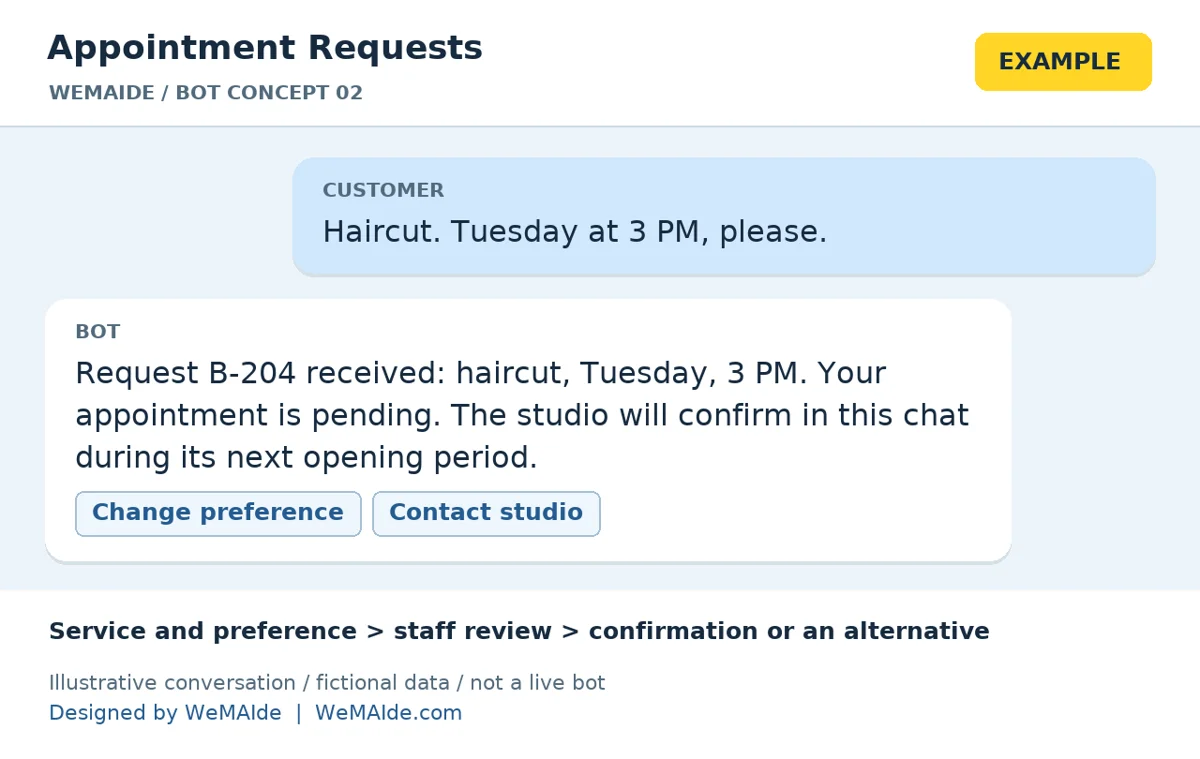
- First release. A request form inside the conversation, one staff inbox and an explicit confirmation step. Display the business’s actual response window and contact route.
- What it needs. Services, durations, business time zone, response hours and the person who confirms appointments.
- Boundary. Instant booking adds authoritative availability and conflict handling. The first version above collects a request; its button should say “Request appointment.”
- Deliverable. A request-and-confirmation flow with a visible pending state.
3. The quote bot that asks the useful questions first
Printing, installation, fabrication and custom services. “How much?” is a fair question. It is also difficult to price when the only attached photograph contains half a wall and somebody’s thumb. A bot can collect the measurements, quantity, deadline and reference files before a specialist opens the request.
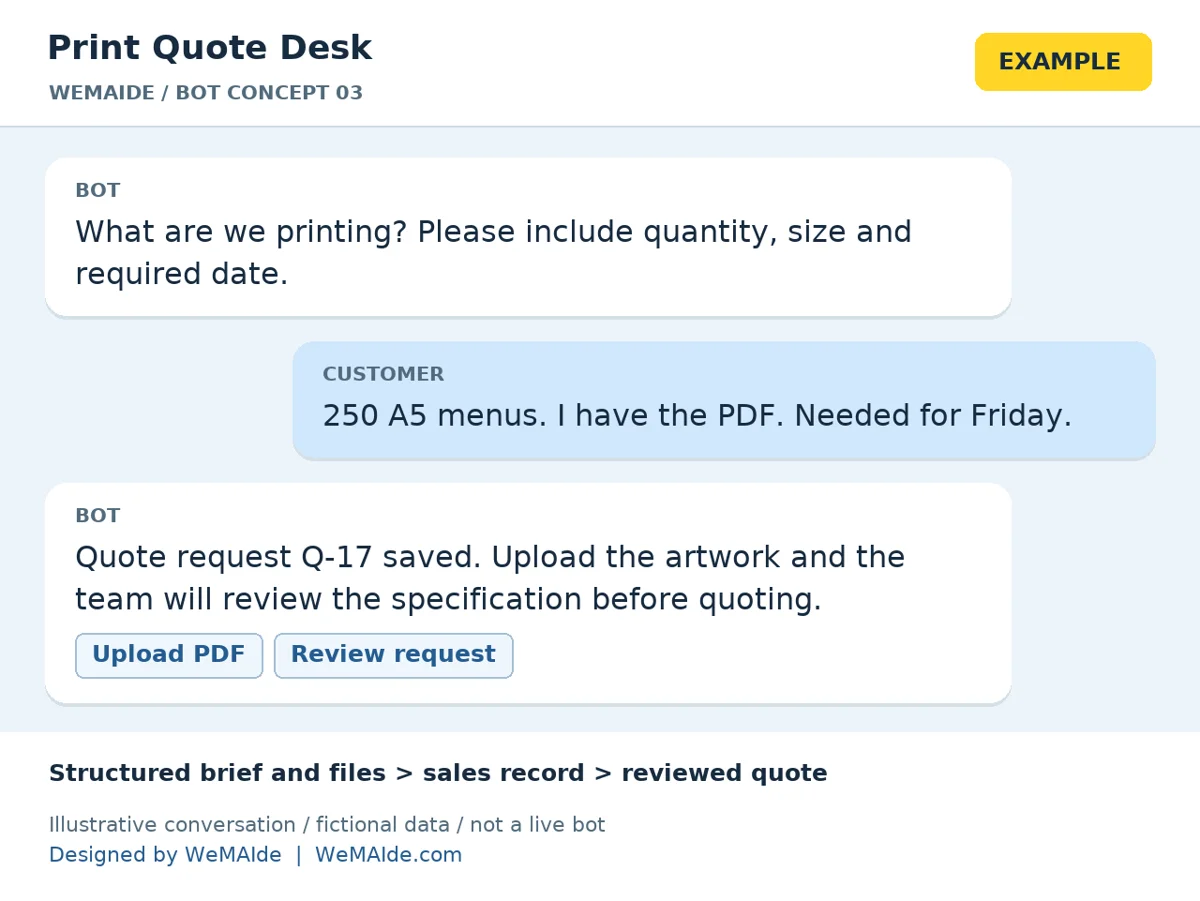
- First release. One service, a short question sequence, a request summary and delivery to the agreed sales destination. Add a calculation only where approved pricing rules support it.
- What it needs. Required fields, accepted files, service area, lead times and the owner of the final quote.
- Boundary. “Request received” is not a final price or an accepted delivery deadline.
- Deliverable. A quote-intake bot that hands a useful brief to a specialist.
4. The order-status bot: retire the human tracking link
Online stores, workshops and order-based services. Somebody on your team has become the loading spinner between a customer and an order system. They open the record, copy the status and send it back. A read-only bot can handle that trip when the customer and order are properly linked.
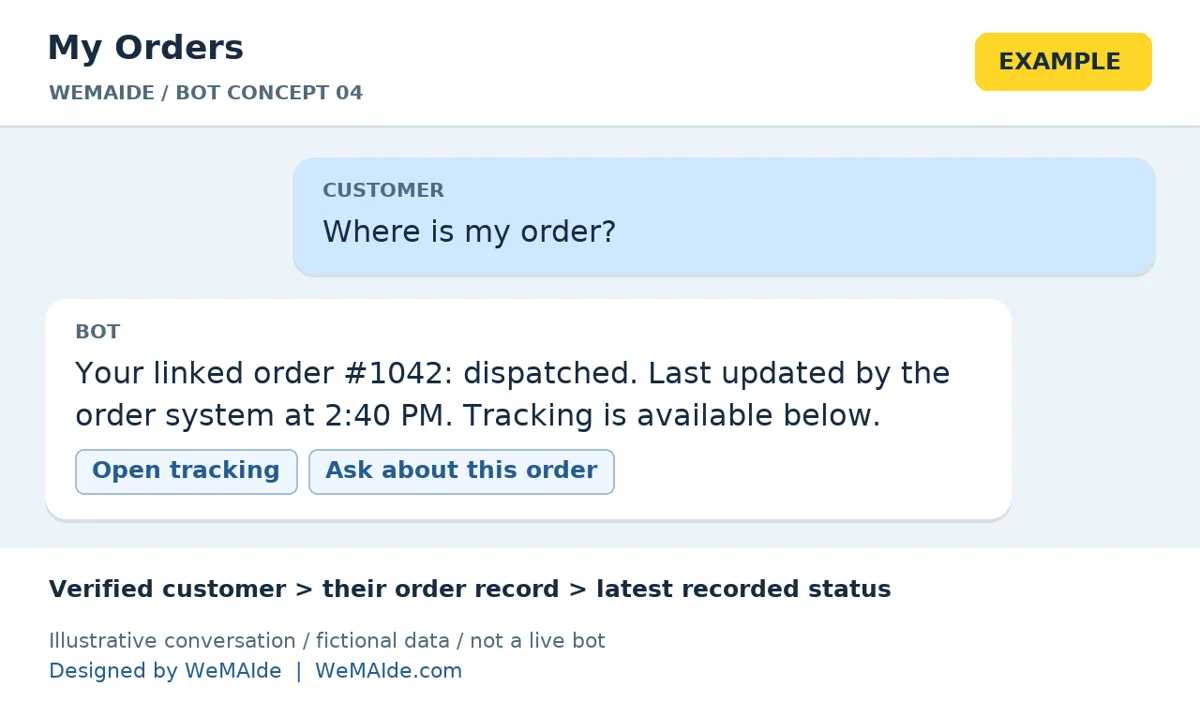
- First release. Read one order source, show a small set of agreed statuses and attach the order reference when a person needs to help.
- What it needs. Supported access to the order system, field mapping and a verified link between the Telegram user and their orders.
- Boundary. An order number alone should not expose somebody else’s record. “Latest recorded status” is more honest than “live tracking” when the source is only periodically updated.
- Deliverable. An access-controlled order lookup connected to one maintained source.
5. The reorder bot for customers who always buy the usual
Office supplies, repeat wholesale orders and local delivery. Your regular customer has ordered the same coffee supplies for months. Every order still begins with a small archaeological expedition through the chat history. Let them bring the previous basket back, change what they need and submit a fresh request.
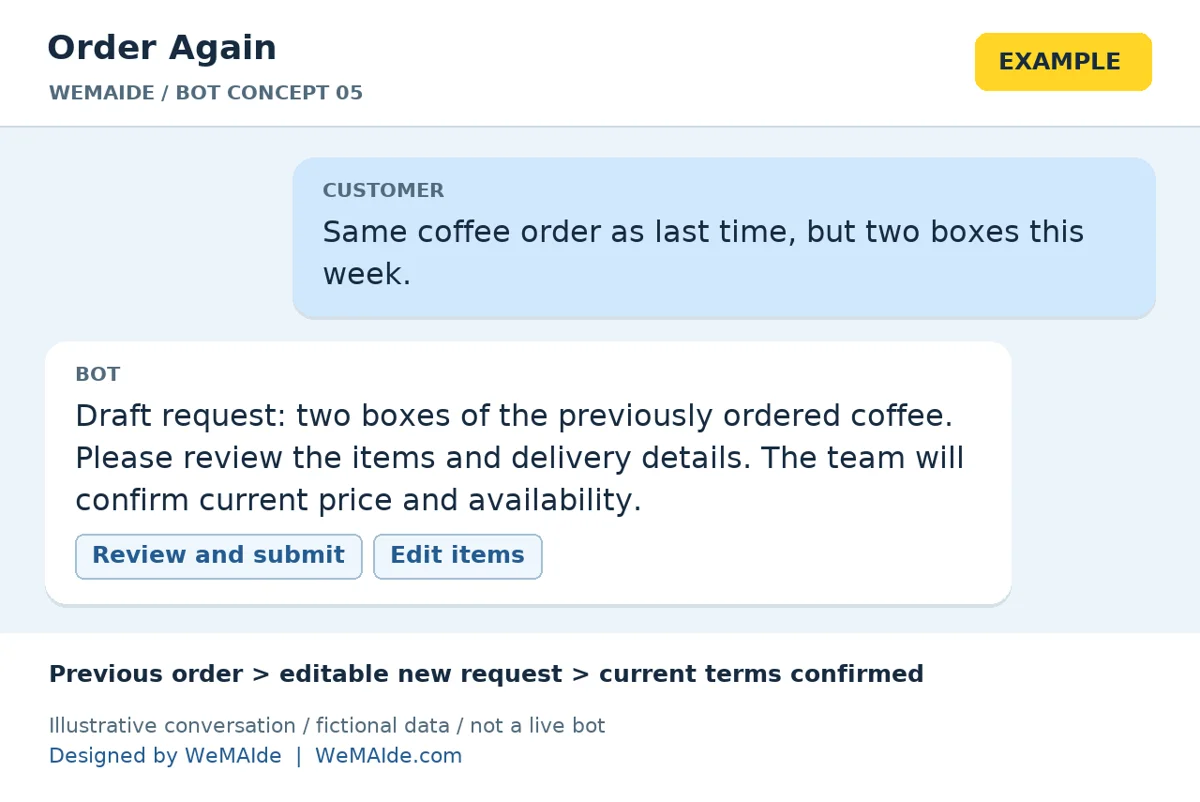
- First release. A “repeat order” action for a limited set of products, with a readable summary before submission. Menu choices can work before introducing free-text interpretation.
- What it needs. Authorized order history, product references and the source of current prices, stock and delivery options.
- Boundary. Repeating a basket should not silently repeat a charge or promise last month’s price.
- Deliverable. A repeat-order request flow with review and confirmation.
6. The product finder that narrows the shelf
Specialist retail and maintained product catalogues. “Show me all 400 products” is a browsing experience. “Help me find a desk lamp that fits here” is a buying task. Ask a few useful questions and return a short list built from the catalogue’s actual attributes.
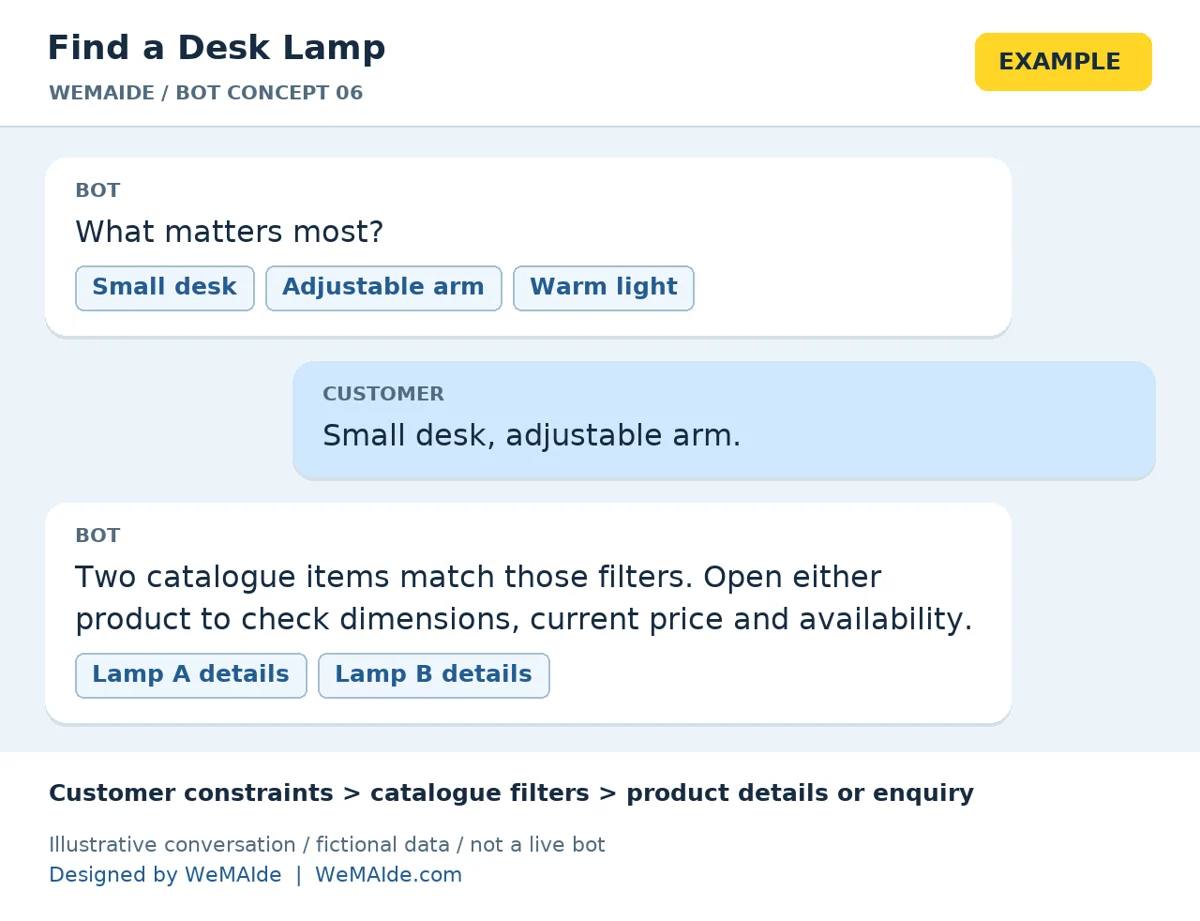
- First release. One product category, a maintained attribute list and links to the existing product pages. Filters can be ordinary application rules.
- What it needs. Consistent product data, approved comparison attributes and an owner for changes to stock and specifications.
- Boundary. The bot should not invent compatibility or treat an old stock flag as a reservation. A larger visual comparison may be better served by a Mini App.
- Deliverable. A guided product selector tied to a real catalogue.
7. The waitlist bot that remembers who wanted the spare seat
Workshops, classes and limited-capacity events. A pottery class is full. Someone cancels. The instructor vaguely remembers a person asking about it in a message somewhere between a glaze photo and a supplier invoice. Give that interest a record.
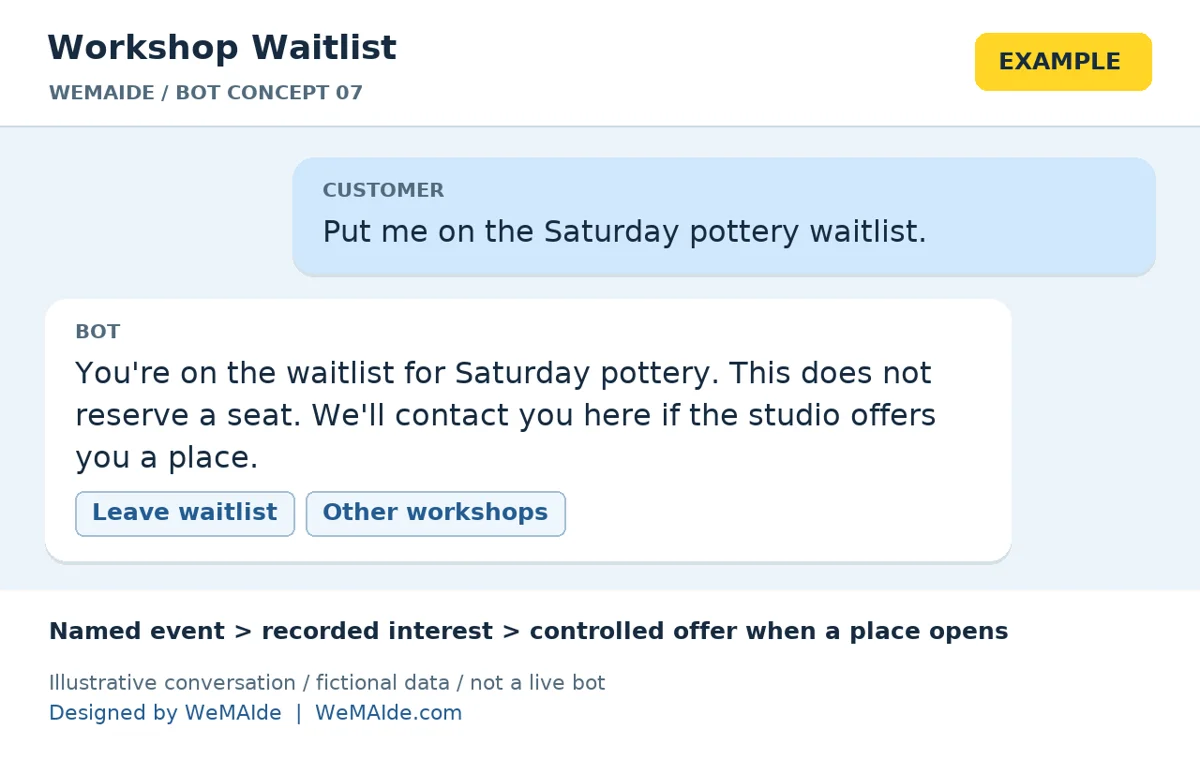
- First release. One workshop list, join/leave controls and a staff-managed seat offer. If offers expire, explain the deadline and keep allocation in one authoritative system.
- What it needs. A class list, capacity owner, offer order and clear rules for accepting or declining an offered seat.
- Boundary. Joining a waitlist, receiving an offer and holding a confirmed place are three different states.
- Deliverable. A visible waitlist with an auditable route to offering a place.
8. The membership bot that connects payment to access
Paid digital communities, lessons and member resources. A member has paid. The community admin is asleep. Access is currently powered by a person noticing a screenshot. Connect the confirmed payment event to a clearly defined entitlement instead.
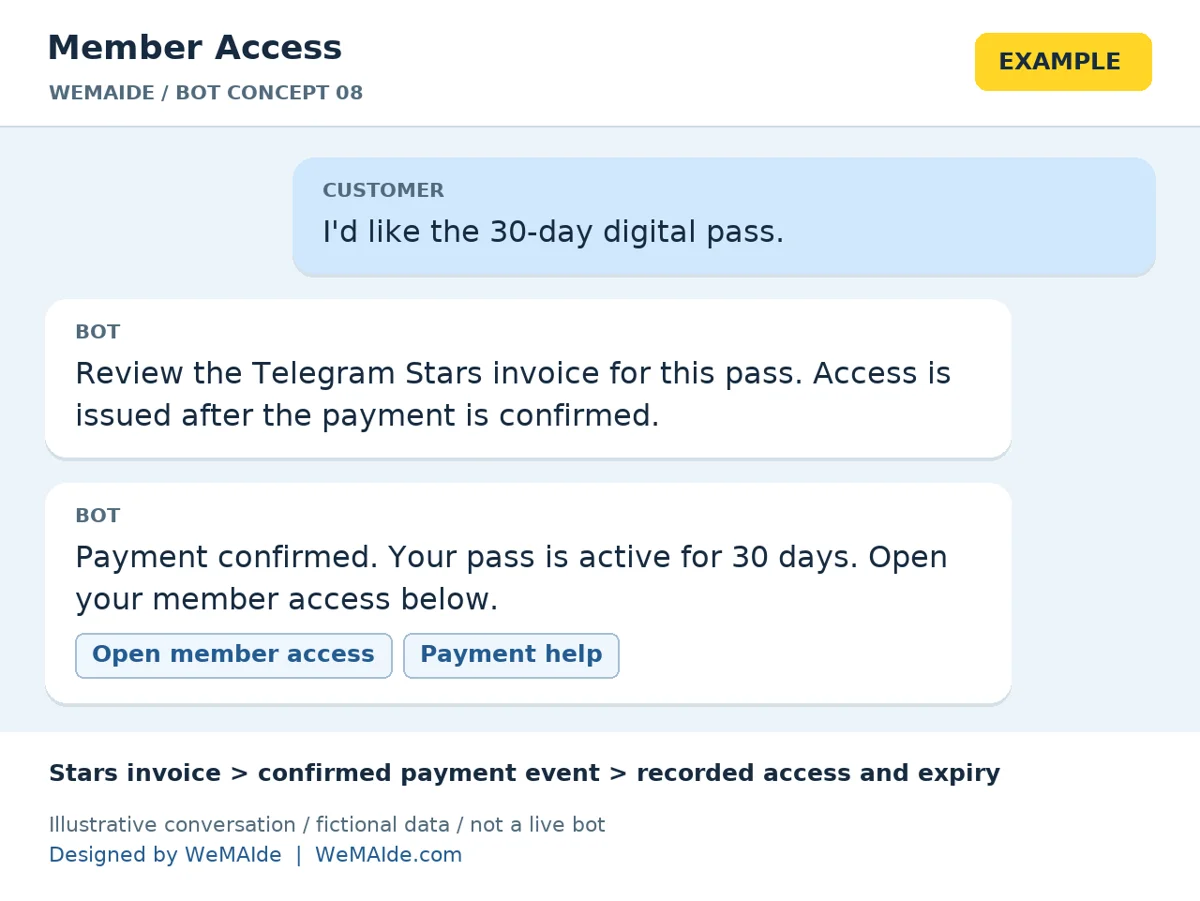
- First release. One digital offer, supported Stars payment, access delivery, expiry handling and a payment-help/refund process. The final message above follows a successful backend payment event.
- What it needs. The content or community, eligibility rules, access permissions and a named payment-support owner.
- Boundary. Digital goods and services sold inside Telegram use Telegram Stars. A Pay-button click is not proof of payment. Native recurring bot subscriptions currently use 30-day periods; a one-off pass and an automatically renewing subscription need different wording.
- Deliverable. A payment-and-entitlement flow with an explicit operating owner.
9. The support bot that hands over a case, not a mystery
Businesses with recurring order or service enquiries. “I need a person” should not trigger a second round of “What’s your order number?” Collect the issue once, preserve the context and put it in the queue the team actually monitors.
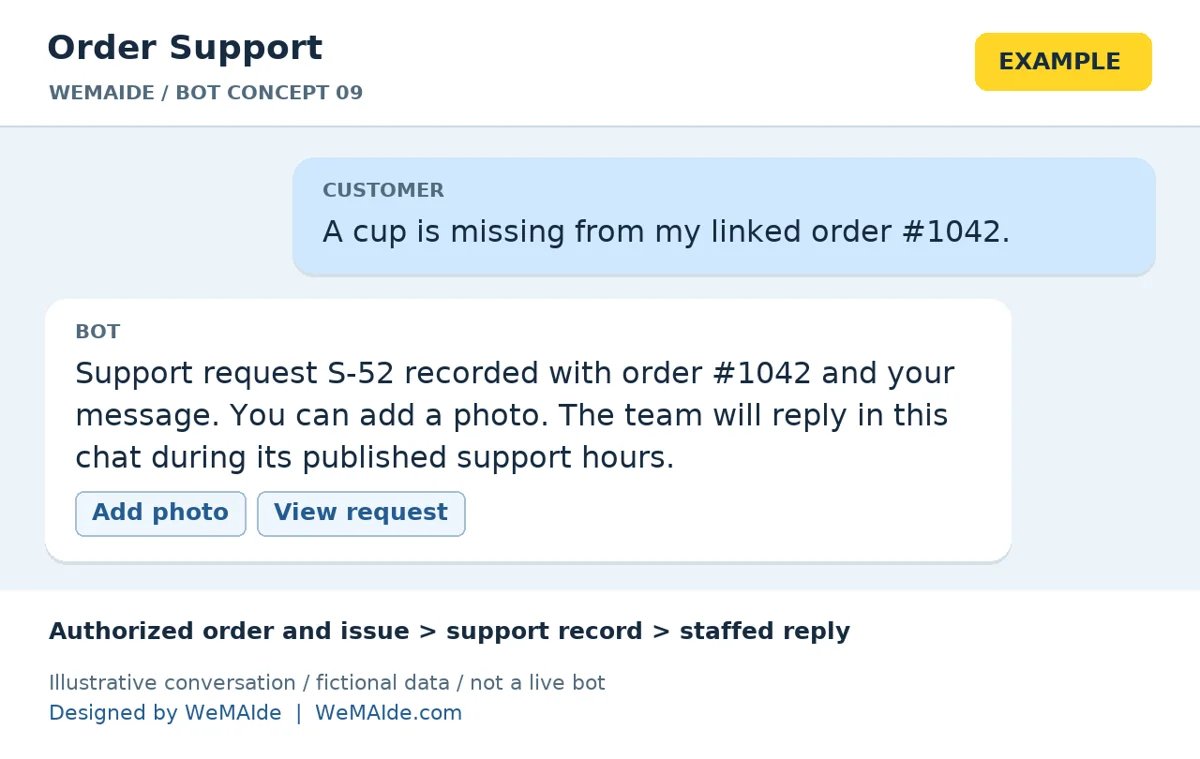
- First release. A small set of issue types, optional attachments, a ticket reference and one staffed destination. Publish the actual support hours and escalation route.
- What it needs. An owner for the queue, permitted order context and a way to return the staff response to the correct chat.
- Boundary. “Request recorded,” “team notified” and “agent responding” should describe what actually happened.
- Deliverable. Structured support intake with context-preserving human handoff.
10. The document-intake bot that ends “which file is missing?”
Suppliers, onboarding teams and document-heavy operations. The file exists. Somebody sent it. Nobody is certain which conversation it lives in. A bot can give every submission a reference and show which required items have arrived.
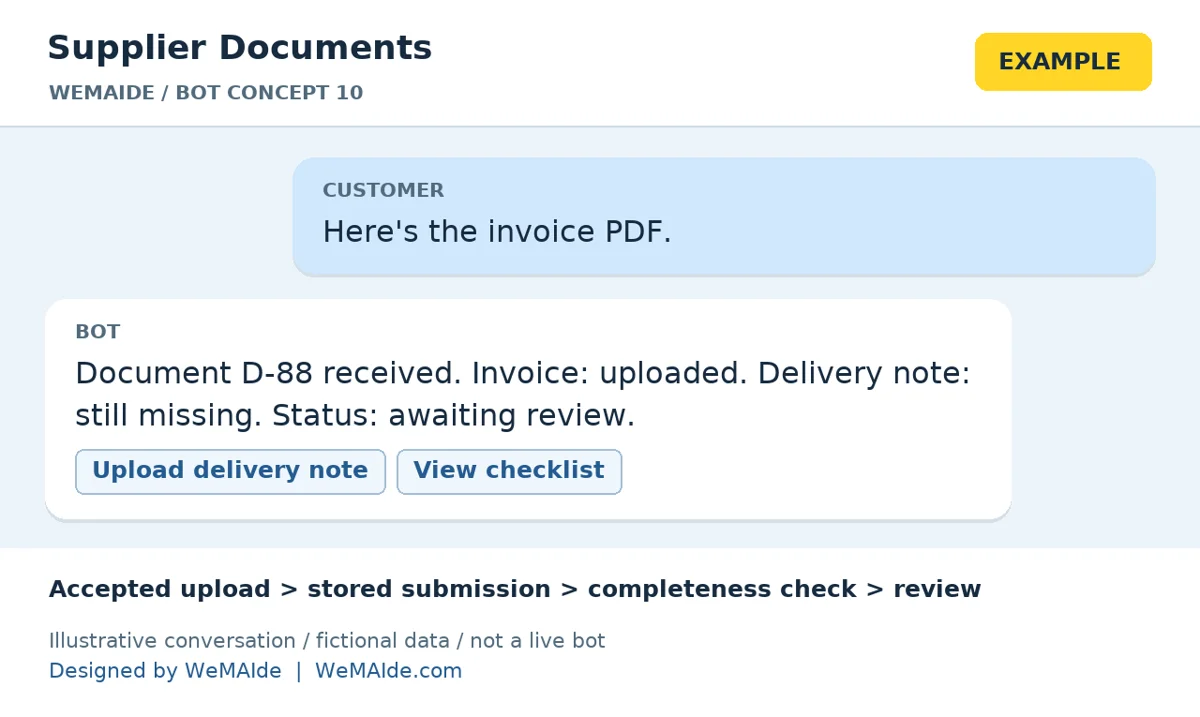
- First release. Two accepted document types, a stated size limit, a submission record and a private review destination. AI extraction can be a later step with source evidence and validation.
- What it needs. A checklist, accepted formats, storage/access rules, retention decisions and the person responsible for review.
- Boundary. “Uploaded” does not mean reviewed or approved. Set file limits for the chosen Bot API setup before promising large-file handling.
- Deliverable. A document collection workflow with visible completeness and review states.
11. The approval bot that turns “looks fine” into a decision
Small teams with internal purchase requests. A thumbs-up somewhere in a group chat is a remarkably flexible accounting system. Give each purchase request an identity, a responsible approver and a recorded decision.
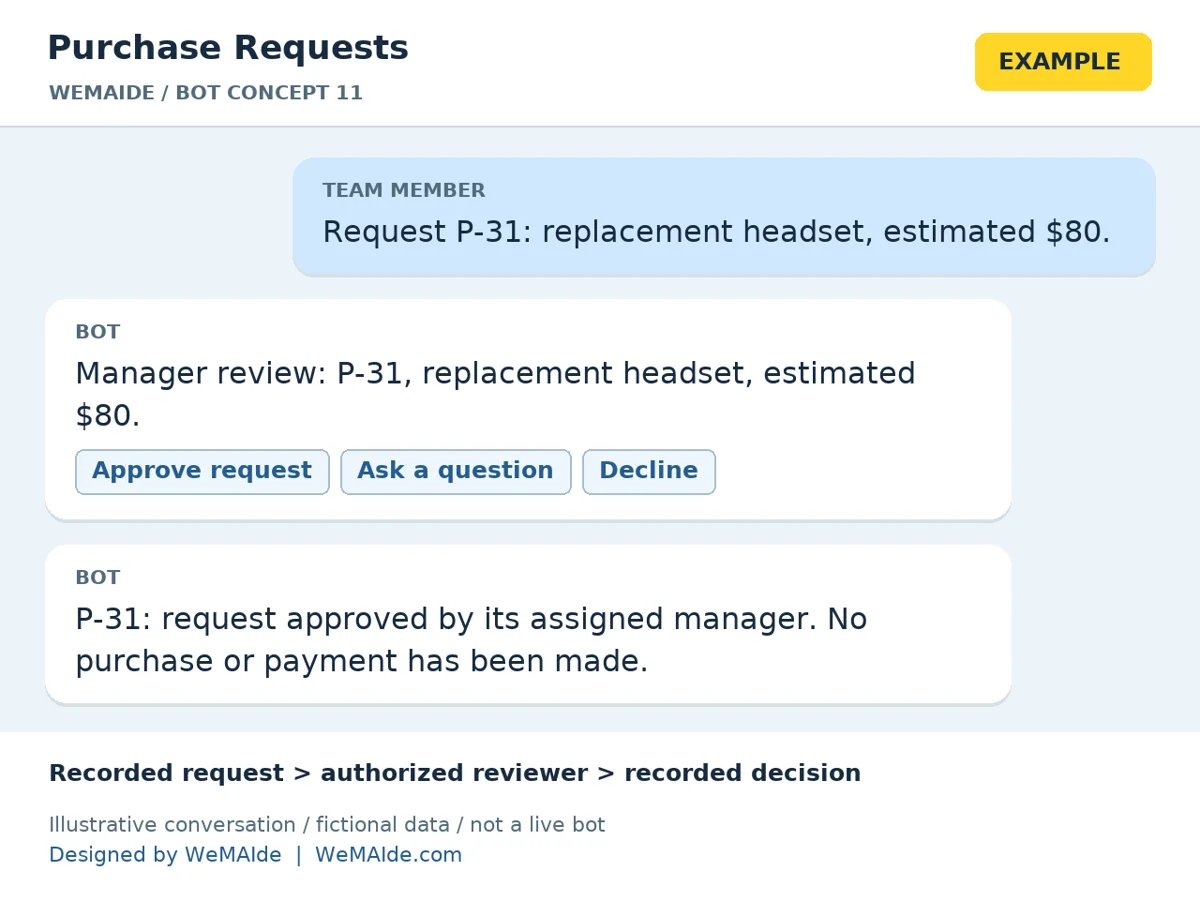
- First release. One request type, two permission roles and a durable decision record. Revisions should be visible so an old approval does not authorize changed terms.
- What it needs. Reviewer mapping, approval rules, request fields and the person who acts on an approved request.
- Boundary. Hiding an approval button is not authorization. The backend must check the actor and the current request before accepting a decision.
- Deliverable. A controlled approval queue with clear ownership and history.
12. The morning digest that points to the work
Owners and operations teams using connected business systems. “Anything I should know?” sends three people into four dashboards. A digest can assemble the agreed exceptions and link back to the records that need attention.
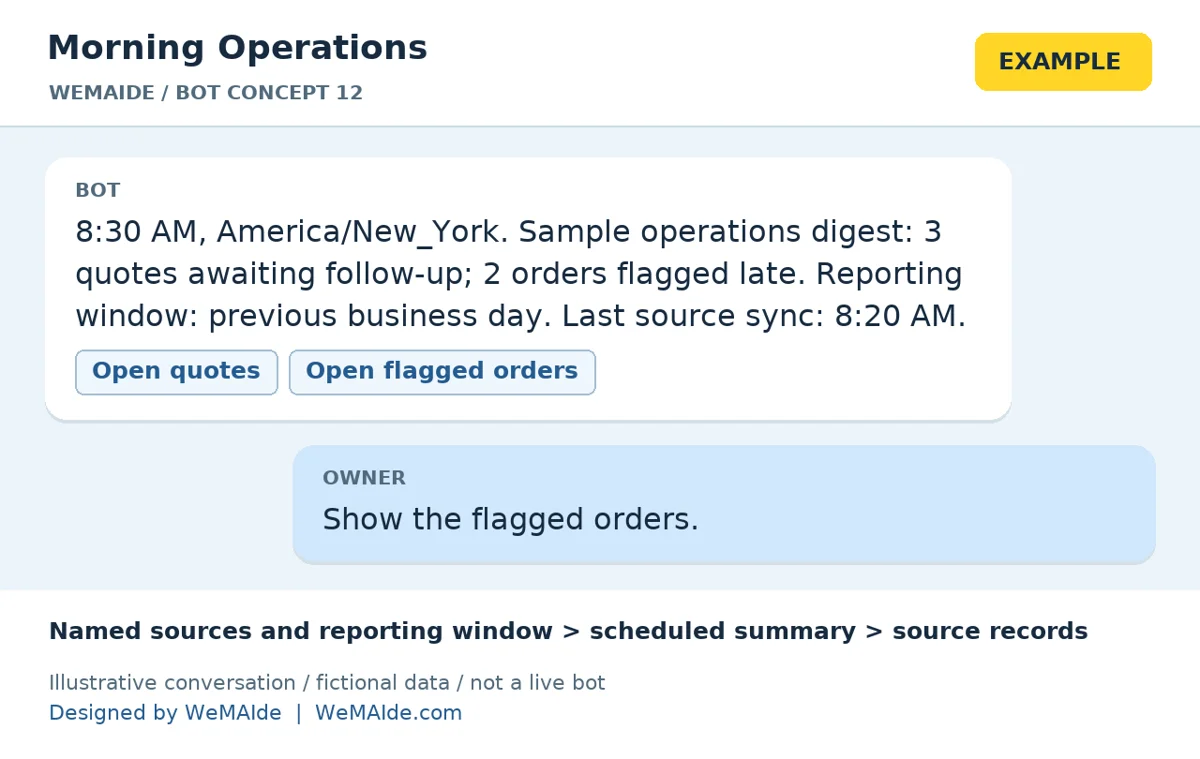
- First release. One owner, one daily delivery time and two useful exception lists from supported sources. Build the schedule in the backend and give the owner pause controls.
- What it needs. Connected records, permission scope, definitions of each exception, time zone and a visible data-freshness policy.
- Boundary. Say when a source did not update. A delivered digest does not prove the owner read it or acted on it; use an explicit acknowledgement when that matters.
- Deliverable. A scheduled, source-linked briefing with an operator-controlled delivery window.
Choose the job before choosing the technology
Start with the channel your customers or team already use. A Telegram bot is useful when it makes an existing habit easier. Asking an audience to install another messenger is a separate acquisition problem.
Pick a job that repeats, has an identifiable input and ends in an observable result. “Help with sales” is difficult to test. “Collect a print specification and put it in the sales queue with a reference” gives the team something concrete to build.
A standard bot cannot begin an ordinary private conversation with a stranger. The user opens it and taps Start first. This makes an opt-in entry point part of the product: a website link, a QR code on a receipt, a community post or an invitation during a real customer conversation.
Buttons and a short conversation are often enough to test the first job. Move to a Mini App when browsing, comparing products or filling a richer form would be easier on a visual screen inside Telegram. A Mini App still needs an interface, backend and operating arrangement.
Give the bot facts, a destination and an owner
The bot cannot repair an availability list nobody maintains. Decide where the current answer lives: the catalogue, order system, reservation system, approved FAQ or staff decision. Then define what the bot may read, create or change.
Name the receiving person as carefully as the receiving system. A request successfully stored in a spreadsheet can still spend its entire life waiting for someone to notice it.
Keep the completion language exact. A request can be received while a booking remains pending. A file can be uploaded while its review has not begun. A purchase can be approved while nothing has been bought. Those states should appear in the design and the acceptance checks.
AI is useful where language is messy: proposing fields from a customer’s message, suggesting a category or drafting an answer grounded in approved material. Opening hours, account permissions, payment status and booking allocation still need their proper sources and application rules.
What changes the development scope?
The visible chat is one part of the project. The estimate also depends on stored records, operator controls, access permissions, integrations, content preparation, deployment and the checks needed before launch.
For the appointment example, staff-confirmed requests are one scope. Live slots, concurrent booking protection, deposits and rescheduling across an external calendar add different work. For the order-status example, the first question is whether the existing system exposes suitable supported access.
Ask for a quote against one complete journey, including its pending and failure states. List the first release, later additions and explicit exclusions. Separate development from hosting, third-party services, AI usage where applicable and ongoing maintenance.
A Telegram bot brief you can copy
You can fill this in before contacting a developer. “Not decided yet” is a better answer than an invented requirement.
- The bot’s first job is…
- The person who will use it is…
- They will discover it and tap Start through…
- They provide these details or files…
- The approved answer or current record comes from…
- A completed action means…
- A pending or failed action should show…
- This person handles exceptions and updates the data…
- The first release includes…; later or excluded work is…
- We will accept the build after demonstrating these example conversations…
A plain-text brief you can fill in and share with your developer.
From a useful sketch to a working bot
WeMAIde designs and develops custom Telegram bots: conversation flows, stored state, integrations, scheduling, operator controls and deployment. The twelve concepts above show how we can turn a repeated business task into a defined first release.
Our published Telegram work includes DON’T SCROLL!, Leela AI and Unf*cking Horoscope. Those projects demonstrate related delivery, product-rule and scheduling experience. They are separate from the fictional business concepts in this article.
If one of these ideas fits your business, bring one actual customer question, the material your team uses to answer it and an example of the result you want. We can scope the bot around that job. A small, complete workflow gives both sides something useful to approve.
The complete reading copy with all twelve sample conversations.
Sources and illustration credits
Concepts and editorial material by WeMAIde with AI assistance. Conversations and interface records are illustrative sample data. Notebook cartoons were created with AI assistance. Platform details checked against Telegram’s official documentation on November 7, 2026.