WEMAIDE / INSIGHTS / GUIDES
Website development cost: budget the pages, the work and the handoff
WeMAIde landing pages start at $800, business websites at $1,500 and focused redesigns at $1,200. Compare hourly development with a fixed price for an agreed scope.
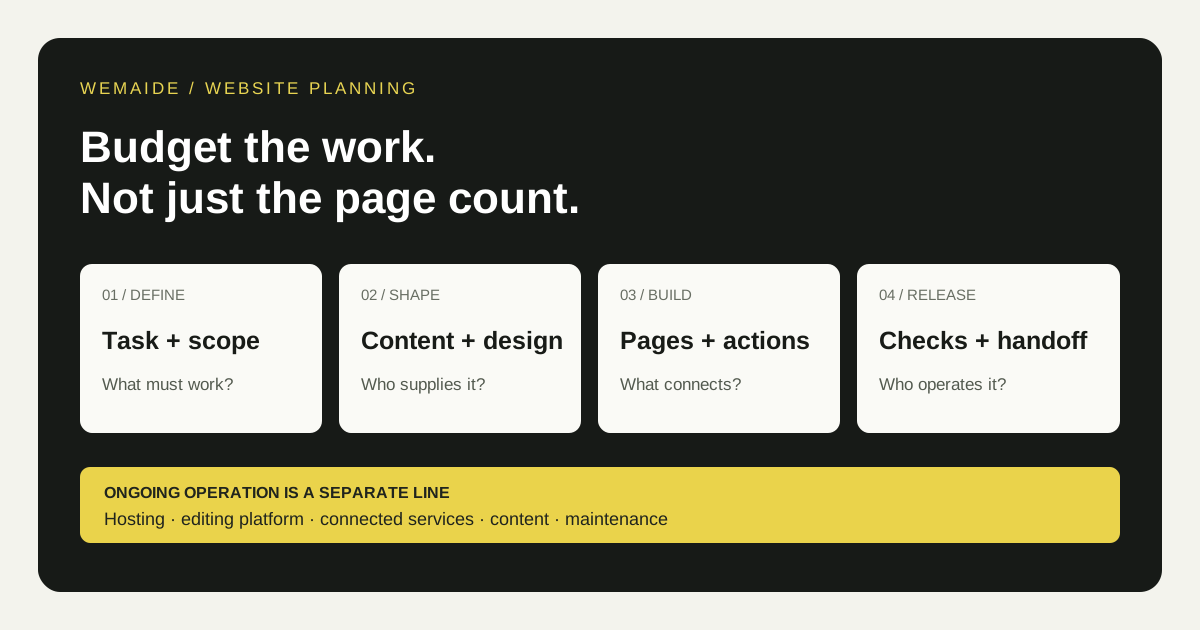
A five-page website can be a small publishing project or the visible end of a substantial system. The difference is what those pages must do, who supplies the material and what happens after a visitor presses the main button. To compare website development costs, ask for the work behind the page count.
At WeMAIde, a landing page starts at $800, a company website at $1,500 and a focused redesign at $1,200. You can pay for actual development time at around $20 per hour or agree on a fixed project price before work begins. All amounts are in USD, before tax.
Start with the website the customer needs
| Scope | What the first release might include | What changes the estimate |
|---|---|---|
| Landing page | One offer, approved content, responsive layout and one enquiry route | Copywriting, custom imagery, form destination and campaign measurement |
| Small business website | Several services, a reusable page pattern, company evidence and contact | Content inventory, editing workflow, languages and distinct page layouts |
| Catalogue or connected website | Browse items and complete a defined enquiry or shortlist task | Data ownership, filters, accounts, live stock, payment or booking connections |
| Redesign | Retain useful material while improving agreed pages and journeys | Old URLs, CMS condition, migration, integrations and release/recovery work |
A page pattern is more useful for estimating than a URL count alone. Ten service pages using one approved layout share implementation work, but still need ten accurate sets of content. One interactive product configurator may need more work than those ten pages together.
Separate the estimate into work you can accept
- Definition: the audience, complete visitor task, page map and acceptance checks.
- Content: who writes, edits, translates, photographs and approves each item.
- Design: representative desktop/mobile layouts, interaction states and reusable patterns.
- Development: pages, editing workflow, data handling and the agreed integrations.
- Validation: forms, keyboard access, mobile behaviour, performance and search foundations.
- Launch and handoff: deployment, content transfer, editing instructions, ownership and recovery.
For example, a restaurant page can send a booking request for a person to confirm. Showing live table availability requires an authoritative reservation system and a way to handle two requests for the same place. A drawing of a table selector does not include that integration automatically.
Hourly development or a fixed project price?
Hourly billing suits a project where priorities can change. At $20 per hour, five hours of agreed improvements would cost $100. You can decide what to tackle next after seeing the result.
A fixed price suits a defined launch. We agree on the pages, features, materials and total fee upfront. For example, if we agree on $800 for a landing page, you pay $800 whether it takes us 35 or 45 hours. If you later add another language or a booking integration, we agree on any price change before doing that extra work.
| Work block | Landing page | Company website | Focused redesign |
|---|---|---|---|
| Definition and page mapping | 3 h | 6 h | 8 h |
| Responsive design | 9 h | 15 h | 13 h |
| Development | 16 h | 30 h | 21 h |
| Content preparation or migration | 4 h | 12 h | 8 h |
| Validation, release and handoff | 8 h | 12 h | 10 h |
| Total example hours | 40 h | 75 h | 60 h |
| Starting budget at $20/hour | From $800 | From $1,500 | From $1,200 |
The landing-page example assumes approved brand assets, supplied draft copy, one contact route and no account, checkout or custom CMS work. The business-site example assumes a small set of reusable page patterns and a limited content set. The redesign assumes that some content and implementation can be retained; it does not assume a platform migration. The hours do not establish how long your project will take.
The hours show how an hourly estimate can add up. For a fixed-price project, the proposal records the deliverables and the agreed total. The starting price depends on having the materials and scope described above.
Website redesign cost depends on what survives
A refresh can improve a header, mobile form or service-page pattern without replacing the whole website. A redesign changes a wider part of the structure and experience. A rebuild changes the technical foundation as well. Compare proposals only after they identify which of these jobs they include.
| Question | Why it affects the work |
|---|---|
| Can useful content stay at its existing URLs? | Keeping an address can avoid unnecessary migration work; changed addresses need mapping and testing. |
| Can the current editing system support the new pages? | A styling change and a CMS migration have different data, training and release needs. |
| Do forms and connected services still work? | Retaining the visible fields does not prove that enquiries reach the intended destination. |
| Which pages need new content? | Old copy may no longer match the business even when the layout can be reused. |
Before replacing a site, inventory important URLs and the pages that receive useful search visits or external links. If URLs change, relevant destination mapping, redirects, updated internal links and monitoring belong in the scope. Google documents the processing involved in a URL move; no estimate can purchase a guarantee of unchanged rankings.
Budget operation separately from the build
Identify who pays for the domain, hosting, editing platform, email or form service, analytics tools and maintenance. Some projects combine several of these in one plan; others do not. Record renewal costs, ownership and what happens when the development engagement ends.
As an example, allow $20 a month for hosting, $10 for forms or email and two optional maintenance hours at $20 each. That comes to $70 a month, or $840 for a year. With an $800 landing page, the first-year example totals $1,640 before tax and domain fees. Actual running costs depend on the services and support you choose.
Maintenance time needs a defined meaning: checking forms, applying suitable updates and resolving defects are different from writing new pages or adding a feature. For a quiet site the allowance might be different; an actively changing catalogue may need a separate content budget. Specify response expectations instead of assuming every future change is included.
Choose a platform around the editing and operating needs
A site builder, a CMS and a custom implementation can each be appropriate. Ask who will change the pages, what the integrations require and whether the team can operate the result. A low initial setup cost may come with recurring fees or constraints; a custom build still needs someone to own releases and content changes. Confirm the proposed platform against the actual project rather than comparing technology labels.
The same applies to AI features. A service website does not need a model request to show an address or collect a form. If an AI assistant solves a real visitor task, estimate its context, checks, failure paths and ongoing usage separately from the basic website.
Make two website proposals comparable
- Give both suppliers the same main visitor task and content inventory.
- List distinct page patterns, required languages and the intended editing workflow.
- Name each integration and say whether the release needs a link, a request or a live synchronised action.
- Agree what counts as a successful form submission, usable mobile page and completed handoff.
- Separate build work, recurring charges, content work and optional later features.
- For a redesign, list retained URLs and material, required redirects and recovery responsibilities.
A free editable text brief with a short fictional example. Use it to compare scopes; no email or account required.
For an estimate from WeMAIde, bring the current site or the source material, the customer question and one action that must work. A complete small release is easier to price, review and operate than a long list of possible pages with no agreed responsibility for the content.